Thoughts about urban space, public art, everydayness, and the sensorial fabric that makes up our everyday city life
Sunday, September 16, 2012
Death, Mariachis and the Loop: John Jota Leaños' "Imperial Silence," Some Commentary
Skirting the line between playful and didactic, John Jota Leaños' opera, "Imperial Silence: Una Ópera Muerta," cajoles, threatens, offends, and woos the viewer using a medley of dance, singing, music, digital media, all drawing on elements from Día de los Muertos, in Mexican public culture, as well as live political issues in the Americas more broadly. Themes emerge: the forgotten, the ignored, violence, celebration. The four act piece opens with flamenco steps as the two virtuoso dancers burst onto the stage wearing, as all the players do, a striking assemblage of peasant style dress, and skeleton makeup turning their movements into a literal dance of the dead. The "Los Cuatro Vientos," four mariachi singers/musicians ever-present both narrating and interceding in the various dramas depicted on screen, also wear skeletal paint, with sequins attached to the curves of their bones to better reflect their internal structure. Proceeding from the first act, "Los ABCs !Qué Vivan los Muertos!" which is rendered in the style of a children's reading primer, illustrating the fate of Abu, to our Homey "who was capped in the ass," and again, to the refrain "Yes, our Homey who was capped in the ass," illustrated by cartoons of child-like skeletons on screen experiencing nuclear atrocity, torture, gassing, murder, neglect, and so forth. Macabre, and also hilarious. Act II presents "Deadtime Rhymes with Mariachi Goose and Friends," an animated series wherein Little Red Riding Hood becomes a gangster conspiracy film, with Red becoming a violent protagonist, the Wolf a neurotic victim, and Humpty-Dumpty a love-lorn mariachi, the paramour of Rapunzel, and Snow White, her conniving sister a crime queen who rides in a "wagon" that bounces like a hydraulic cadillac and works with Red to plan the annihilation of Humpty-Mariachi, and the Seven Dwarves who are instead malicious thugs. In various intermezzos the dancers appear, frantic feet tapping out violent rhythms, in a frenzy similar to that of the Red Slipper, performing the violent (erasure) of Mexican GI's who were murdered by their platoons, performing balletic acrobatics to conclude by giving the audience the finger, partner-dancing while switching the lead from male to female, scrambling masculinity as well harmony. Another intermezzo occurs with the cheerfully delivered song "The House that Blacks Built," chronicling the domination and aggression of whites against blacks and how now "Tra la la" who cleans the House but "A Mexican!" Act III, "!Radio Muerto! y el Muertorider" tells the story of the Muertorider, a Cadillac with black and white woodcut prints with "La Katrina" in the hub, and various scenes of violence and neglect on its sides, showing its construction, circulation, targeting by the police, and even its career as a touristy showpiece and photo booth. As the animated skeletal driver, presumably on Route 66, drives his lowrider, the ""Los Cuatro Vientos," play music, and then fade out as other programs are tuned in, with a focus on "Poor Radio" covering the "Poor," where a heart-rending tribute to the Poor Newscaster's dead mother is delivered, and the story of indigenous annihilation is told by RedBull the Noble Savage. Finally, CNN and myopic news reporting is lampooned in Act IV: "DNN: Dead News Network," where the reporter called "Donasque Dontatella" who is "dead on the scene" tells the story of a "Million Muerto March," an occupation of the White House with unclear goals, the non reporting about Juarez occurs (and doesn't), as well as a blithe "Think Local act Global" spokesperson and "La Katrina" weatherwoman explain that the solution to global warming is a positive attitude and being "chill."
Impossible to fully describe given its wide topical range, aesthetic complexity, and that, importantly, it works as a spatial practice with the tonalities of the singers, physicality of the dancers, and the weird juxtaposition of bodied and disembodied voices and images that is performative and not merely textual, "Imperial Silence" illuminates the productive possibilities in encountering death as an aesthetic and cultural resources that should be collectively negotiated, not managed and held at bay, and again asks the question, what does it mean for us to negotiate memory, history, and violence aesthetically? It provides a provisional answer in the performance itself: director Jota Leaños stated at the opening of the matinee, that the production engages death in ways that are often written out in the U.S., and he explained to the audience"Some things might not taste as good as they look...so take what you like...experimental theater is about...serious play."
The notion of "serious play" in conjunction with death, both as theme and empirical inevitability importantly has its roots in what might be seen as an understanding of mortality and community that is actively worked out rather than repressed in Mexican culture. In León, Guanajuato, when seeing the celebrated aerosol mural piece "Las Katrinas" outside the Nicholas graveyard, Wes told me, We see death here, in Mexico, and we can talk about it, a sentiment later underscored by Nikkis.
The Day of the Dead is an occasion for death to become a public art: worked out, practiced, communicated with, where mortality is understood not the end of but a crucial element of humanity. It is apropos, then, that Jota Leaños uses death, in a sense all of the players in the opera are "Las Katrinas," as a quilting point through which multiple kinds of violence can be negotiated, republicized, and introduced into public memory.
The opera is chaotic, but so its violence, publicity, and morality. The final rave scene is an exhuberant, carnivalesque, opaque performance of hyperstimulation, embodiment, and excessive enjoyment in the face of and potentially because of death.
Octavio Paz notes: "Everything in the modern world functions as if death did not exit...But death enters into everything we undertake, and it is no longer a transition but a great gaping mouth that nothing can satisfy. the century of health, hygeine and contraceptives, miracle drugs and synthetic foods, is also the century of the concentration camp and the police state, Hiroshima and the murder story...The word death is not pronounced in New York, in Paris, in London, because it burns the lips. The Mexican, in contrast, is familiar with death, jokes about it, caresses it, sleeps with it, celebrates it; it is one of his favorite toys and his most steadfast love....The cult of life, if it is truly profound and total, is also the cult of death, because the two are inseparable. A civilization that denies death ends by denying life...It is useless to exclude death form our images, our words, our ideas, because death will obliterate all of us, beginning with those who ignore it or pretend to ignore it." (Labyrinth of Solitude p. 57-60).
"Imperial Silence," then is a form of "serious play" for the audience; an occasion to meditate on and work intensely with the supposition: what would it mean for death to be integrated into life, and for us to personify, dance with, and account for death. And what does it mean for the above to take place in a collective register?
This serious play, to play on words, does not intend for the above exercise to be fully comfortable: at every juncture the United States, and Whites, are implicated in ongoing schemes of erasure, domination, and violence of many kinds. The female dancer, after allowing the audience to watch her and her partner elegantly move, and strike the floor with their feet, challenges such viewing privilege by giving the finger. However, even the representation of violence is beautiful. It is unfair, perhaps, to fault the venue for diluting some of the political heft of the piece because of its location, in the lovely theater at the Museum of Contemporary Art. But it seems to me that the location is central: announcing prior to the beginning of the Ópera Jota Leaños stated that the performance was not "for a tourist gaze" but for those of us who are cultural outsiders, who get to enjoy it, might it be?
Very smart scholars such as Phaedra Pezzulo have written extensively about the relationship between tourism and death, and how it can still be a politically redeeming endeavor. Here, though, I want to put the accent, and perhaps the question mark alongside the question of enjoyment, and whether, in Jota Leaños' framing, we can distinguish among different kinds of enjoyment in ways that might yield more productively attuned forms of citizenship. Specifically, how might place be implicated more critically in the performance itself? Michigan Avenue is the consumptive-tourism hotspot in Chicago, and importantly, it is a place where visitors can have an anxiety free experience of urbanity- something that presents itself as metropolitan, but precisely without many discomforting scenes of poverty, violence, mental illness, infrastructural decay, emptiness, and racial tension. It allows high-end retail stores to stand in synecdochically for Chicago as a whole, a Chicago that is home to thousands of Mexican immigrants, the site of immigration protests, local businesses, vibrant art scenes, gang activity, church activity, stoop dwelling, informal economies, and so forth. Chicago is a place where death is zoned geographically, and shootings in "safe" areas are highlighted as a surprise and ongoing street violence in "shady" areas is relegated to the normal. So it is with profound gratitude, and interest that I got to see this performance of joy, death, and re-memorialization in a strange theater, within an urban non-place, to use Marc Augé's terminology.
The Ópera concludes: "!Silencia! !Silencio! ?Se puede? !Sí se puede! Has llegado a la frontera de la muerte, La tragedia é nacita! Lloren, no rian, La Vida nos une..." The inverse to the opening which solicits the listener to laugh, not cry, because death unites us.
Monday, June 18, 2012
Tats Cru Headquarters: Px12's Public Participation
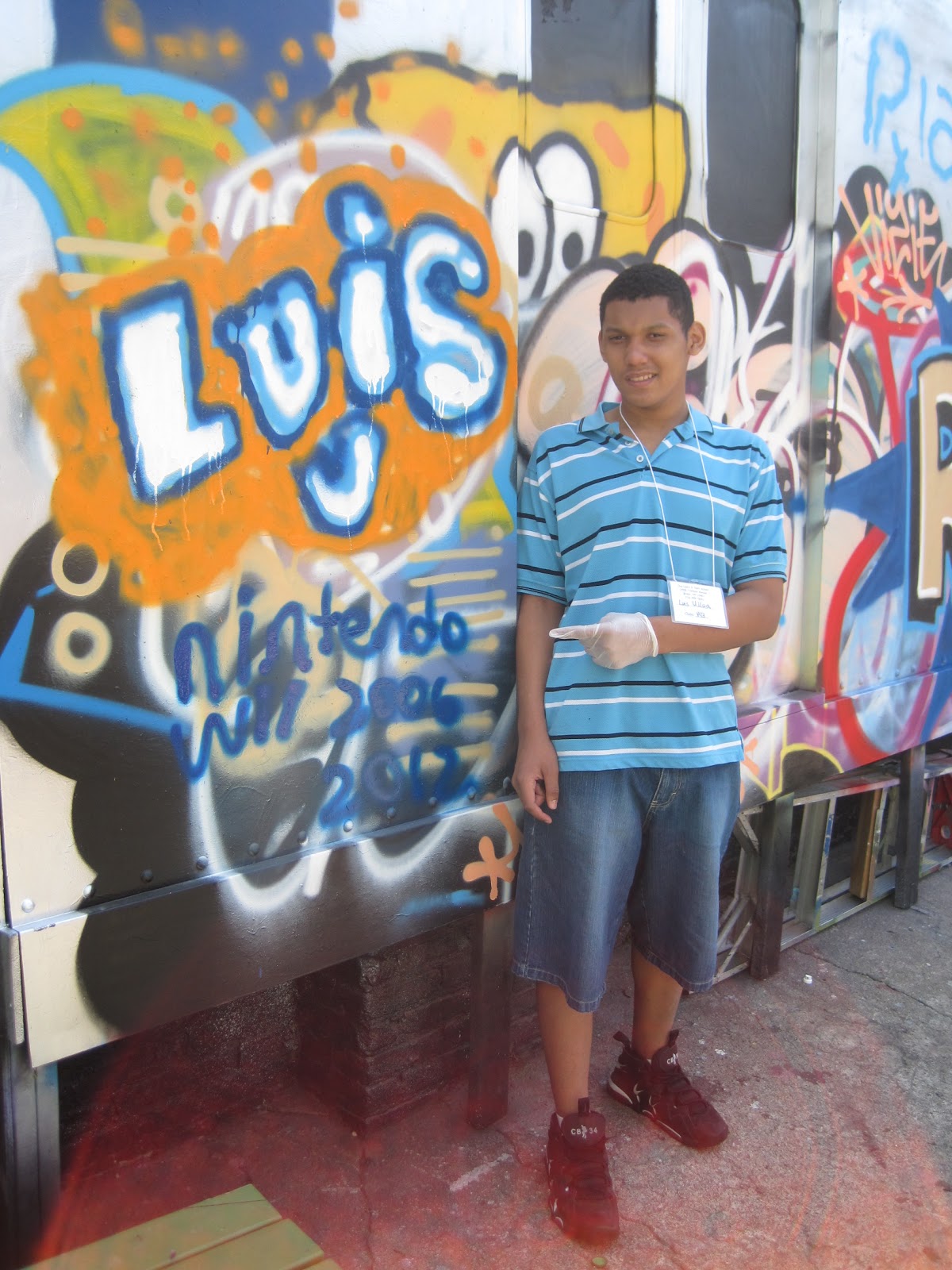
Today I went on a trip with my mother’s students to Tats Cru headquarters to meet with Bio, one of the crew’s members, and for the students to learn about graffiti. We arrived in the Hunt’s Point neighborhood, large boulevards striated with faded and not so faded markings, a series of bodegas, chain stores and people hanging out on sidewalks, at corners, in lawn chairs on the street, coming out of the 6 train station into the din of construction and food trucks and cars. The office is located next to a theater building, and enclosed by a metal gate and brick walls. Within there is a small garden, and then potted plants in vertical and horizontal formations. Paint and flowers side by side. Bio greeted us and gave everyone a poster calendar with prints of the crew’s murals on it, an we went up to the second floor of the little room where he pointed to toys they collected from travels across the world, stickers from different artists, and then photographs from artists they have met over time. I noticed a ‘StayHigh” signature over the door, reminding me of the artist’s recent passing. Then we went back downstairs to look at the ‘train’ which Bio said had been painted over by a bunch of artists and didn’t have much fancy on it, because they had had a barbeque with out of town artists.
After walking through a courtyard with an L shaped wall with three murals on it and a bed of vegetables and flowers in the angle of the walls we turned out into a repurposed parking area. There, a plyboard wall had been turned into a subway car, covered with tags and throwups, and the four students stood in front of it in awe. “Do you want to paint?” Bio asked the students. “Yeah!” one responded enthusiastically. Another retreated to a bench. Bio disappeared and came back with four plastic gloves and four spray cans, a light blue, dark blue, white and orange. He told the kids to hold the can close to the wall, straight up and town. First hesitantly, in constrained spaces, and then across more sprawling distances the students delved into painting for forty minutes. Bio interjected with suggestions for making wider or thinner line width, color selection and font tips. Abraham, a 6’2’’ student grinned widely “I like this!” Luis, who has an obsession with video games, wrote “Supermario brothers,” “WII,” and “Legend of Zelda Anniversary Edition.”
Shamaria, who had been sitting quietly on a bench a little ways from the wall finally wrote her name, carefully and with intense focus. The para, Ms. Barbara, wrote her name and her son’s names “I could get used to this!” she said laugh. Bio walked us to look at an older mural, done in 1995, on the front of the theater adjacent to the TATS CRU office, and talked about the free programming there, and how TATS CRU used to teach mural classes. “How did you learn to do art?” Abraham asked “In junior high, from friends, just starting in books, looking at cartoons and comics and copying them” he responded. “I want to do more” Abraham said, and Bio laughed. “That’s how I got started too.” My mom, their teacher, added “But always ask permission—otherwise you will get in trouble.”
The students are all “alternate assessment,” meaning that
they have been diagnosed with varying levels of autism or other mental
disorders, and frequently have issues engaging in activities, paying attention,
and working independently. Painting on a fake New York City subway car, although I had mentioned to them that the Bronx and New York were important in the history of graffiti, they were at that moment performing the same practices that youth had done decades before them, enacting a kind of kinesthetic sympathy with older artists through the practice of bringing finger to nozzle of paint can to wall.
At the
wall site they exhibited intense focus, playfulness and creativity, and a
desire to develop artistic skills.
Seeing other public murals with recognizable figures, a “I like cookies
not war or brutality” cookie monster mural, for instance, they commented on
such icons, asked to be photographed with them, and engaged in a kind of public
sense making. A writer, Haste, mentioned that art is a form of “color therapy”
that changes urban spaces. In the
Hunt’s Point neighborhood these visual markings were prominent between the 6
train and the Tats Cru office, as well as in my own neighborhood of Inwood in
upper Manhattan, where I saw a piece showing a bridge that read “Community” on
a grate near the 207th street bridge. Bio and his crew have gone to Mexico City, in the 1990s,
painted international art figures such as Nikolaev and Vorotnikov from Voina,
and welcome international artists like Banksy to their studio. Watching the students react and
respond to different color schemes, abstract representations of interconnected
brains or feminism, suggests that the visual is a way to activate urban
citizenship, and deliberate engagement and participation is an important way
for youth to have a sense of connection to neighborhoods, and broader locales.
Thank you to Bio of Tats Cru for letting us see your office, spending time with us, and letting us experience the joy of writing.
Wednesday, March 28, 2012
Atmospheric Non Futures: "Destino al lugar del siempre"
In Puebla this week there is a conference, hosted at Benemerito Universidad Autónoma de Puebla (BUAP) on women, literature and art. By sheer coincidence a colleague, unlike myself, actually familiar with the city, is attending a different conference at BUAP this week. We, along with his Puebla family, arrived late after making our way through the different terminals of Benito Juarez Airport in Mexico City, and driving through the seemingly unending edges of Ciudad de México. It is an eerie feeling, leaving D.F., the intense crash, clank, honks and whistles of activity die out suddenly and you are left with hills and varying air pressure (and altitude) the ghostly smattering of light a reminder of the megapolis being left behind. Puebla, on the other hand, at least the Centro Historico, has a more manicured and relaxed feel: kids, teens, adults and the elderly loiter around the Zócalo square, backpacks are left against columns of the surrounding plaza as workers repair some tiling on a balcony, and plants are held in pretty painted pots around the square as a fountain gurgles in the middle. People walk at a less frenetic pace, and there are several concentrations of pedestrian only zones, with two-lane only streets. In short the Centro Historico fosters intense sociality, has regions for encounter and rest, and is part of an urban ecology of architectural distinction, a high level of upkeep, and relative security.
One of the activities for the conference was the inauguration of some paintings, which circle around themes of femininity, masculinity, the erotic, and violence. Taking place in Casa Bovédes, a casa de cultura with classes and talleres, in its courtyard, a stone area surrounded by yellow and black columns and arches which blend into railings for the second floor balcony, paintings were placed around the recessed floor which had a fountain in the middle, allowing viewers to circulate around the paintings, and gather in the center. A band played on the stage on the north side of the building, and a food and wine station was set up on the south-west side. Conference attendees and youth at the center for other classes (a dance class had ended moments before) entered from a door on the south side of the building which opened up to the main street, Don Juan de Palafox y Mendoza, and bodies spilled into the courtyard in a triangular trajectory, around the paintings installed on the southwest and southeast sides. The paintings formed sticky visual surfaces which arrested the motion of the crowds arriving, like a fly in a web, and reoriented trajectories to talk about the work, reflection, posing with it in pictures, or, in the case of some, giggling about some of the overt sexuality. The installation was overtly temporary: on mobile easels the paintings had a fragile hold on the installation space, underscored when someone bumped into a stand that was adjacent to the food and drink table and knocked a painting off the scandalous crash followed by laughs and shrugs when glass was not broken. A live band played, stopping between songs to remind us about the conference, and to be proud of the women who helped put it together.
Within the jovial scene of networking, relaxation, inebriation, and food consumption the paintings and photographs occupied a slightly discordant, though productive place. Images of a male nude with his head chopped off, a woman in a white mask with a knife and three playing cards, a headless woman holding a monstrous visage, a photograph of a woman on a crucifix head turned away hair covering her face wearing only a loincloth, and nearby a woman in a small canoe, hair undone, staring down at her feet, almost invisible in the blue of the sea and the sky. The last work, "Destino al lugar del siempre," "Destined to go to the forever place," by Alexandra Deloya Vélèz 2012.
The woman standing in the boat is dominated by the surrounding environment, swallowed up by the blue of the ocean that meets the blue of the sky creating a zone of indeterminacy where the small canoe balances, holding the naked woman in her retiring stance. The upward curve of hte front of the canoe throws into relief her vulnerability, and the dangerous act of standing in a boat in an endless sea. hHer body is offered to our gaze but she is spatially put out of reach, esconced in an atmosphere of suspension. Destined to go somewhere...forever. Forever destined to go...to be in transit. Destined-to go...the rush of the waves against her boat accentuate different possible futures, non futures, trajectories without completion. Her head is hung down, making her voluminous brown hair encircles her shoulders almost reaching her breasts, hand hung limply at her sides, left hip jutting out and right knee slightly bent, a posture of resignation, exhaustion, or also holding herself in reserve. A gaze withdrawn saying you may look but your look will not be completed and the body that is the object of contemplation is far out to see, constantly receding.
The boat, "The Tomorrow," in "Children of Men," which is either the sign of a future or the sign of defeat recedes into the grey holding Kee and her child, Dylan, a promise at the very least of a short period of community within the boat. "Destino al lugar del siempre" holds no such promise: it with-holds the possibility of the female body being a conduit for social completion, pulls away and holds it in abeyance.
Now, within the space of the busy inauguration gathering the melancholic tones of the paintings strike a discordant note, but an important one: they highlight the ordinary affects that gendered subjects experience on a day to day basis. Desire, defeat, refusal. By refusing to offer us the straight on gaze of a demand, a plea, explicit communication, and instead presenting bowed heads, turned faces, masks, vaginas, and facelessness they demonstrate the incompletion of mere recognition, the day after of violence, what it means to live in a present that is structured by failed promises. And it is seductive. The woman in the boat pulls you out to sea into a space not structured by demands, sympathy, and senses of fulfillment, but a heady atmosphere of non futurity.
Subscribe to:
Posts (Atom)