Saturday, March 22, 2014

Epi2mik: Virality, Infection and Communicable Affect


In The Transmission of Affect Teresa Breannan describes affective force as a sort of contagious force. One can catch the blues from another, and equally, be infected with shared joy. Thierry O., best known as Epi2mik, a street artist from Caen, Normandie, opened his ephemeral show 22 March 2014 at Cabinet d'Amateur in the 11eme arrondissement, a series of drawings and watercolor paintings that explore the structure of malady in a range of visual forms, ranging from the leering, to the joyful.
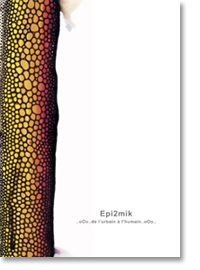
Epi2mik Flyer. Cabinet d'Amateur. Paris, France. 22 March 2014. Photo Credit: Caitlin Bruce

Epi2mik's show offer's a series of four by six inch panels, at eye level, that run from one end of the small gallery to the next. The opposing wall is punctuated by a few much larger pieces, potentially offering"contaminate the city, its walls, its urban furniture, and its trees."
Epi2mik.  Cabinet d'Amateur. Paris, France. 22 March 2014. Photo Credit: Caitlin Bruce

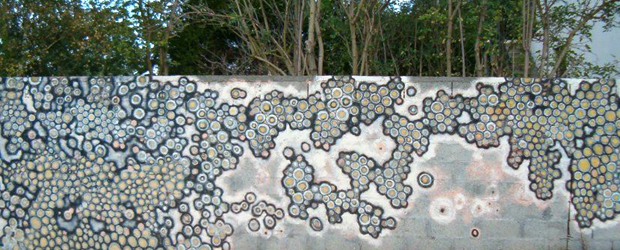
 an enlarged microscopic view of the structure of the cells across. He notes: "[I use the name] Epi2mik [pronounced 'epidemic'] because I make circles in the street that multiply, like a malady, and I return, again and again to the same location, so that it grows and grows. Here at Cabinet d'Amateur I have done a series of drawings with paint." Asking him to elaborate on the political context for his work he added: "I find that we live in an era of malady. And for those that work in the street, it is a little like a kind of therapy...and for me [epidemic] symbolizes all of what our generation must live within. It is an immediate reaction to the extreme right, and other problems.""Has anything changed, since you began with this epidemic?" "No. For me? No. I continue to work in the street and to also do smaller paintings...its a different kind of work [paintings] but it is something I like to do very much."

Indeed he has noted at greater length what the generalized condition of malady may signify:

« Pour moi, cela symbolise tout ce que notre génération vit de négatif : sida, chômage, corruption, montée de l’extrêmedroite, dérives du capitalisme, etc... La ville est mon tableau. J’essaye de valoriser des endroits abîmés, usés ou désaffectés pour réaliser ces compositions qui sont comme des warnings citoyens. »

For me, this [the circles] symbolize all of the negativity that our generation lives with: HIV, unemployment, corruption, the rise of the extreme right, the drifts of capitalism, etc..The city is my tableau. I try to valorize spaces that are damaged, spent, or unused to create compositions that are warnings for citizens.
Epi2mik. Cabinet d'Amateur. Paris, France. 22 March 2014. Photo Credit: Caitlin Bruce


Although each piece is composed of circles, connecting at their edges to form various shapes, their composition, color, and density varies intensely, offering a wide array of emotional states and structures of forms. Although the pieces in the gallery were composed inside, Epi2mik remarked that his larger outdoor projects could take up to ten years to create. "I return one day, and paint a few circles, I leave, and then return another [day] adding yet more..." He further contextualized that he had worked in the street for fifteen years before working in galleries. Patrick, the owner of Cabinet d'Amateur, had contacted him earlier in 2013 to participate in an exposition on street art. "I find it interesting to do drawings, to do things other than what I would do in the street...to work also in color, and in small format."
Epi2mik. Cabinet d'Amateur. Paris, France. 22 March 2014. Photo Credit: Caitlin Bruce
His practice, which is gradual, points to how it is that urban landscapes are transformed in broader contexts, involving subtle changes that would be difficult if not impossible to recognized over the immediate feature, but leaving an indelible impact in the long term. The evolutionary nature of his craft is a broader tendency, often recounted by graffiti and street artists, as central to both genres. Asking him to elaborate on the theme of evolution Ep2mik responded: "When I work in the street...I'll first arrive with paints in warm colors...some red, some yellow...I return the next day and I add to it, and the people see the building evolve and evolve in equal measure with the painting

 I could not encounter the exhibit without thinking of Gilles Deluze's work in Difference and Repetition where repetition is not the eternal return haunted by the tyranny of the same, but instead is always with a difference yielding new and unpredictable outcomes. Such an ethic, to reproduce the same signature (or image) while allowing it to alter and be altered by its surrounding is one that can be read more generally in street art cultures.
Epi2mik. Cabinet d'Amateur. Paris, France. 22 March 2014. Photo Credit: Caitlin Bruce
Yet, in the context of Epi2mik's work, this imperative to repeat but not repeat, is even stronger. It raises questions, however. How do we define what constitutes repetition? Is it the use of a similar structure, or ingredient? This, to me, requires thinking about the repetition involved in Epi2mik's work as a question of arrangement, or invention, not recreating the circle, but deploying it at various scales in different concentrations and orientations to yield what may, at first glance, appear to be a new image. Sure enough, Epi2mik has noted in earlier interviews that:

Mon travail est urbain mais n’a pas grand chose a voir avec le graffiti, j’utilise la ville comme espace « rhizomatique » et « micropolitique » mes principales influences sont  et dans « Milles Plateaux« , ou  dans « Un art contextuel« , ou encore plus proche la contamination de .
Epi2mik. Cabinet d'Amateur. Paris, France. 22 March 2014. Photo Credit: Caitlin Bruce
My work is urban but it is not exactly like graffiti. I use the city as a "rhizomatic" and "micropolitical" space, and my principle influences are Gilles Deleuze and Felix Guattari in "A Thousand Plateaus", or Paul Ardenne in "A Contextual Art," or yet even more recently the contamination of Joel Hubaut.


Moreover, the simplicity and strength of Epi2mik's compositions, circles that are joined organically, almost (seemingly) accidentally to form a larger organism, is infections. Leaving the exhibit I was able to read patterns in worn patches of sidwalk, and eroded swatchs of retaining walls.
Visual Contagion. Rue de Reuilly 12eme. Paris, France. 22 March 2014. Photo Credit: Caitlin Bruce
Returning to my apartment I was unable to return to the blog post an a separate exhibit I was already composing, or to my other duties. His work elicited associational patterns in other viewers. An elderly woman at the exhibit noted: "Is there a relationship with medical institutions?" leading Thierry's partner to call over the artist to discuss his work with art as a kind of therapy.

This exhibit reminds us of one of the qualities of street art that is so powerful. It is not only that street art often offers a disruption or reaestheticization of degraded or ignored urban space. It is that street art, and public art more broadly, provides a reorientation or intensification of vision, allowing us to experience our surroundings anew.


Merci beaucoup à Thierry pour l'entretien, et à Patrick pour l'access à votre superbe galerie. L'expo est fantatique.

Sunday, February 23, 2014

RERO ERREUR DANS LE TITRE: Laborious Reading and the Ellipsis

RERO. "The invisible is in the visible beyond the look." Backslash Gallery, Paris. February 2014. Photo credit: Caitlin Bruce

RERO, a French street artist, is known for his strike-through text, inscribed within (and upon) prestigious art institutions such as the Centre Pompidou and the Grand Palais, as well as abandoned spaces (Backslash Gallery Exposition Summary). His current exhibit at Backslash Gallery in the 3eme arrondissement explicitly experiments with the perceptible, the imperceptible, and the erased. Arial style font inscribed upon metal, paper, wood, and wallpaper, witty phrases taunt, tease, and escape the viewer (and their camera). Through difficult to read color combinations, or the actual use of physical barriers, RERO makes it hard to access his various texts.

RERO. "From word to deed..." Backslash Gallery, Paris. February 2014. Photo credit: Caitlin Bruce

First, RERO's use of physical obstacles in the gallery space transform it from a space of pleasurable looking, to one of uncomfortable deciphering.
RERO. Long view, upper floor of gallery. Backslash Gallery, Paris.  February 2014. Photo Credit: Caitlin Bruce
The piece in the far back, which presumable reads (or is deciphered as) "Je vous attends dehors," "I wait for you outside," is the first of such physically blockaded pieces. The piece, which is inscribed directly onto the gallery space, is covered in an aged piece of wood, rough and worn. The combination of the strikethough, the obscuring board, and the ellipses lend to the piece a sense of mystery, a hidden message, but a message that is only reluctantly given, and then recanted, or made ambiguous.
RERO. "Je vous attends dehors..." Backslash Gallery, Paris. February 2014. Photo credit: Caitlin Bruce
As a street artist, RERO emerges from a milieu where the unreadable or the illegible is not necessarily a bad thing. For many graffiti artists, by having an unreadable (to non initiates) signature enables to communicate in the light of the public, but beneath and around its penetrating gaze. The urge for legibility, readability, and easy translation, Chicago-based artists Stef and Raven suggest, is the logic of typographic capitalism that writes out the spiritual, complex, and layered communications that constitute human exchange. A second obstacle piece, this time inscribed around a bottom corner of the gallery reads:

RERO. "La nature prefere les ____ aux impasses." Backslash Gallery, Paris. February 2014. Photo credit: Caitlin Bruce
What does nature prefer to impasses? What does the typographical, struck through text, so mechanical in aesthetic and form, have to do with nature? The ellipsis, which extends this piece, and many of the others, speaks to further ambiguity and the continuance of thought.

In a recent Artforum piece, Lauren Berlant explores the ellipsis:

Oh yes, the ellipsis! I’ve been working on ellipses as infrastructures of relation. When I saw the black balloons in Forlesen, I had to laugh, because they appear as a kind of exploded ellipsis, and Ellipsisturned out to be their title. Pope.L was playing with the flesh’s thingly temporality. At the opening, all of the black balloons were inflated, and by the end the helium had gone out of them and they were all on the ground—shriveled, sexual, uncanny and more, but not identical. That’s part of the show’s orchestration of negativity too. The balloons look like afterthoughts, the way they are scattered, because they don’t take up the same kind of concentrated monumental space as the big wooden cock. And yet…The thing about an ellipsis is that it has a set of contradictory meanings.An ellipsis is a sentence that I don’t end because…I don’t know how to.An ellipsis is a sentence I don’t end because…you know what I mean.An ellipsis is a figure of return that isn’t symmetrical.Ellipses might be a figure of loss or plenitude: Sometimes it is more efficient to go dot dot dot. Sometimes it’s also a way of signaling an elision. Sometimes the referent is beyond words.
The ellipsis, Berlant muses, serves as an "infrastructure of relation," that "has a set of contradictory meanings...a figure of loss or plenitude" that sometimes may be "beyond words." As a reading method for thinking relation in a way that allows thought to continue to move and grow, the ellipsis can serve as a visual sign of the not-yet-finished, a signal of an idea's non-sovereignty, or a space of reduction or "efficiency." In "Error in the Title," RERO's pieces leverage ellipsis in the context of charged normative (struckthrough) terms, such as "ESCAPE" but also in more enigmatic, seemingly less risky contexts.

Ellipsis, for RERO, also figures as a space of suspension, literal and affective. Many of the texts are suspended in a plastic laminate, white on white, only distinguishable from slightly protuding from the page, and difficult to capture with camera, as they attract the florescent gallery lights and cause glare.
RERO. "I can't believe in my words." Backslash Gallery, Paris. February 2014. Photo Credit: Caitlin Bruce
In "I can't believe my words," a text which seems to have braille text covering it, is encased within a sheer gloss and suspended against a reflective metallic surface. The book's pages are dog-eared, ripped and shredded, lending a sense of age and aura to the object. RERO's declaration of doubt, "I can't believe my words..." is elevated from the text, literally cut out of it, but also struck through, an editorial gesture of withdrawal. So is it that he can't believe his words" or that he cannot NOT believe them? Here, the strikethrough creates a complicating double negative, creating additional ambiguity around the declaration of linguistic uncertainty.

A similar gesture is adopted in the piece adjacent:
RERO. "Don't tell me the truth." Backslash Gallery, Paris. February, 2014. Photo credit: Caitlin Bruce
One could also read the pieces as anticipatory, as one of the more declarative suggest (albeit after being crossed out):
RERO. "Something will happen here..." Backslash Gallery, Paris. February 2014. Photo Credit: Caitlin Bruce
The unreadable also emerges as lack of space. Pieces where RERO emerges all spaces between words to create what, on first glance, seems like a dense but nonsensical assembly of letters, to what, after closer (labored) reading, creates a paragraph.


The piece above notes: "This work presents a landscape in which swarm toxic things and pollutants: Their invisibility is not an indication of their non existence. Their realities play in all manner of ways in the sphere of the invisible, and it gives to their presumed presence a space that is quasi-unlimited..."

The invisible is not the non existent. The invisible creates an unlimited space of play, but also toxicity, the deadly pollutant. Positioned next to a (seemingly) empty canvas of burlap, in juxtaposition the space of apparent emptiness is referred to a space that contains a landscape of pollution, invisible but real.


In the exhibition write up, the curator quotes Pascal Quignard:  "To write is to hide a message, to confide to external memory that which does not make any noise, that which buries the words, as if they sleep, in a space for waiting, reserved for that one who will find them because he knows the code that allows him to bring them back to life."

"Ecrire c'est cacher un message, le confier à une mémoire extérieure qui ne fait pas de bruit, qui ensevelit les mots, comme endormis, dans une attente, résérvés à celui qui saura les trouver parce qu'il connaîtra le code permettant de les faire revivre."

As a closing ellipsis, a piece that directly signals RERO's attachment (however ambiguous) to a graffiti lineage is disclosed.
RERO. "Une contradiction pour chaque graffiti et chaque graffiti a sa contradiction..." Backslash Gallery, Paris. February 2014. Photo credit: Caitlin Bruce


It observes: A contradiction for each graffiti, and each graffiti has its contradiction... 
A repositioning of the Marxist law of contradiction, of materialist dialectics, the phrase points to the repetition and becoming, rule of identity and difference contained in any and every object. "Development arises from the contradictions inside a thing," Mao Tse Tung notes, attempting to explain historical change outside of a bourgeois frame. RERO's mobilization of the law of contradiction could be read to align him with Marxist ideology. It can also be read more ambiguously as a textual strategy, being and non being, writing and striking out, that is concluded in an ellipsis or a gesture towards a future thought that may (or may not) be the undoing of the prior thought. Mobilizing graffiti style across spaces in a way that undoes its own polemic, RERO uses legible text to create a site of laborious reading and uncertainty, working against its seeming transparency. Using the space of the gallery as active participant, RERO also draws attention to the protocols of visibility and invisibility that shape spectatorship in a high art venue. Strike throughs and ellipses render unstable polemical interpretation, as well as the sovereignty of the viewer. Pleasurable, frustrating, and hard to locate, "Error in the Title" is a provocative meditation on signification, invisibility, and the potential.

RERO. "Visible (in)Visible" Backslash Gallery, Paris. February 2014. Photo credit: Caitlin Bruce.

Tuesday, February 18, 2014

Public Art as Longitudinal Process: Traces of Potentia Between Intent and Reception

How can we generate a reading of public art objects that accounts for the social life of their production, their expressivity, as well as the public interest or disinterest that they inspire? By reading public art as longitudinal process, that carries the traces of its social imprints, falling somewhere between authorial intent and numerically accountable public reception.

After receiving thoughtful questions, from reviewers and audiences, about two of the dissertation chapters, the first detailing the affective event of a women's art exhibit in Bellas Artes, Mexico city, a center of cultural patrimony, and the second outlining an ethic of corporeal engagement and generosity inculcated into a mural project by virtue of the dance photographs that generated the mural's content and form, I've been pressed in various ways to locate my readings of the art works within audience perception, reception and reaction.

However, although such reception data, culled through interviews, participant observation, and media impact, will tell us an interesting story about what public art does to others, I fear that such a hierarchization of reception above processes of production, investments, and formal engagements with historically charged spaces will relegate such thematics to a conceptual underworld of epistemological and conceptual frailty. As a result, I am inclined to suggest that we also consider public art to be the agglomeration of the social practices, affective investments, and place based engagements that create formal and affective qualities within the piece itself as a kind of potentia. Simply, if we read public art as a rhetorical event, with its own aesthetic qualities, dramatic expressions, and emotional entailments, it becomes clear that although audience impact (or, "success") are important elements of a rhetorical scene, they are not its only determinants. Methodologically, by attending artist aspirations, investments, and processes, we can consider artists as rhetoricians, and understand that their work has a certain agency and realm of potential impact that, even if not fully realized, constitutes part of the rhetorical scene.
"How Philly Moves." Photo Credit: Caitlin Bruce

To flesh out this argument I will be working around one part of in my analysis of the "How Philly Moves" mural at the Philadelphia International Airport where I suggest that the mural production process implicates the mural's aesthetic and rhetorical potential. I claim that the mural cultivates what I describe as "kinesthetic sympathy," a process of bodily attunement that seeks to encounter fellow citizens as dance partners rather than obstacles. I locate the bulk of this reading in the engagement of photographer, JJ Tiziou, with his dance subjects, the product of which are the photographic images that were projected onto parachute cloth, sketched out, painted, and then laminated onto the PIA Parking Garage as the finished mural. For the most part I investigate how photographing dance, and then painting photographs, creates an intermedial conversation between aesthetic idioms that reveal important insights about ethical engagement by  urban bodies located in a milieu of difference.

The airport mural was created by taking photographic images JJ Tiziou had captured of dancers, projecting them on a drop cloth, tracing them, and then painting them onto parachute cloth that was installed on the airport parking garage walls. As a result, the mural is neither simply painterly rendering, nor photographic realism, it is instead a complex conversation between painterly and photographic idioms.
"How Philly Moves" Gallery Display. International Baggage Claim.  Photo Credit: Caitlin Bruce

The original photoshoots that took place were not necessarily geared towards producing images for a mural. Tiziou had been turned down for a grant to install the images in SEPTA stations, so instead, via crowdfunding, produced the series of images for not-yet-determined ends (Tiziou interview 2010). The second set of photo shoots were geared towards producing more potential images for the murals.

Yet, Tiziou's dance images can, even the ones not taken with the expectation of muralistic alchemy,  be described as painterly. Rather than capturing movement at 1/500th of a second, as Lois Greenfield does, to create a realistic and detailed rendering of dance movement (Reason 45), Tiziou's images are blurry. This way of approaching dance photography is not new. From Arnold Genthe's 1915 photograph of Anna Pavlova as she leaps into the air, one of the earliest images of moving (not staged or still) dance images, "communicates movement beyond the moment it depicts-- beyond, in a sense, what it reveals photographically to what it evokes in the mind of the viewer...the degree of blur in the photograph provides an indistictness that is suggestive of something in motion; oddly, the partial obscurity of the picture prompts viewers to imagine more than they can see...neither documentary nor part of what can be called photographic revelation...instead representation." (Reason 44)
"How Philly Moves." Photo Credit: Caitlin Bruce

Matthew Reason's account of dance photography provides a compelling reading of the formal qualities of dance photos that blur the revelatory (verité) with the representational (imagination). Photography, a still medium, accounts for movement by "undermining its own essential characteristics of revelatory authenticity," (Reason 45), or, by becoming more painterly. At the same time, photography has historically impacted painting, making it more revelatory than representational. In the late 19th century, as a result of Muybridge's Locomotion series, painters began to impost photographic frames on their work, cutting off parts of bodies to fit them within a frame, changing representations of motion, perspective, and bodies (Scharf 186-190). Paradoxically, although photography was hoped to expand the scope of the visible, when it comes to representing motion, photography must instead render the "impression of movement" by imposing a blur, using "emblematic signifiers of movement," that refer, spatially and temporally, to spaces and times outside or beyond the image, and beyond the visible. Through the still, dance photography uses artful construction to create movement "experienced in the mind of the viewer." (Reason 63) Thus, dance photography is a realm where fiction and fact, painting and photography, collide in order to generate kinesthetic impressions in the mind and bodies of viewers.
"How Philly Moves." Photo Credit: Caitlin Bruce

In "Post-medium: Richter Painting Photography," Rosemary Hawker explains that in our contemporary moment "a great many art works are made using more than one medium," or, in the case of Gerhard Richter, arriving at a medium "by other means," practicing photography by painting (Hawker 263). The Philadelphia murals combining photography and painting is not a new conjunction, though it makes more explicit a long-standing relationship between photography and live or ephemeral arts as a means of preservation. Krauss explains the photography has been "dispersed...across the arts" since the 1960s (Hawker 267). Citing Krauss, Hawker elaborates:


Krauss recognises the impossibility of referring to questions of medium outside of the Greenbergian conception where ‘a medium is purportedly made specific by being reduced to nothing but its manifest physical properties’.24 Krauss maintains that, despite the prevailing reductivism of this view of medium, which saw painting’s significance as medium reduced to the flatness of its surface, artists such as Marcel Broodthaers continued to work with different media in such a way as to
emphasise and exploit their heterogeneity. Such artists: "understood and articulated the medium as aggregative, as a complex structure of interlocking and interdependent technical supports and layered conventions distinct from physical properties. For them the specificity of a medium lay in its constitutive
heterogeneity—the fact that it always differs from itself."25
In this way, Krauss argues, the specificity of a medium cannot be reduced to the physicality of its support or the unity of its means. She describes Broodthaers as layering media supports and conventions in order to produce a ‘network’ or ‘complex’ of media.” (269)

"How Philly Moves." International Baggage Claim Gallery. 
In this account, a medium's specificity does not rest in its primary materials. Rather, mediums exist through relationships with other mediums, and how "it always differs from itself." This Derridean reading of medium as differance suggests that medium is constructed and based on its relationship with others, a dialogue between mediums (Hawker 270). Drawing on Foucault's reading of Fromanger's photo-paintings, Hawker further explains that there has existed, particularly between 1860 and 1900, a "'shared practice of the image, accessible to all, on the borders of photography and painting, which was to be rejected by the puritan codes of art in the twentieth century.'...A time of liberated image making when artists, photographers, and amateurs alike made us e of all means at their disposal...'[These] years...witnessed a new frenzy of images, which circulated rapidly between camera and easel...with all the new powers acquired there came a new freedom of transposition, displacement and transformation, of resemblance and dissimulation, of reproduction, duplication and trickery of effect...there emerged a vast field of play where technicians and amateurs, artists and illusionists, unworried by identity, took pleasure in distorting themselves. Perhaps they were less in love with paintings and photographic plates than with the images themselves, with their migration and perversion, their transvestism, their disguised difference...." (Hawker, quoting Foucault, 270).
"How Philly Moves." Photo Credit: Caitlin Bruce

Foucault describes the mid 19th century play between photography and painting not as medium pollution or contamination, but rather as a field of experimentation, blurring, and exciting circulation. It also presciently describes our contemporary moment, where images of still images, and stills of moving images, have increasing capacity to circulate virtually. Using the term "image" rather than photograph or painting, or combination thereof, Foucault suggests that "the image lies at the intersection of the rhetorical trajectories of each medium. Photography and painting are apprehended at once and in the same place, that is, in the image." (Hawker 272-273)

Thus, the "How Philly Moves" mural is an image that emerges at the intersection of dance, photography, and painterly practice, an image that contains within it the complex trajectories of multiple mediums. Yet, the collision of mediums does not result in a completely legible image. Instead, they are what Hawker designates as "idioms...the element of language that is untranslatable yet, paradoxically, known only through its translation and its failure." The failure of fully translating movement, stillness, and painterly expression reveals something about each mediums, only "graspable in another medium" (Hawker 274). By replicating photographs on the walls of the Philadelphia International Airport, the mural reproduces the failure of the photographic medium to fully reveal movement but only to gesture towards it. Moreover, the mural bears the trace of the photographic encounter between photographer and subject, blown up to hundreds of feet, to create a space for encounter between viewer and airport, a space of engagement, and a space of inscrutability.
Big Picture Alliance's Documentary. On display at Philadelphia International Airport International Baggage Claim. Photo Credit: Caitlin Bruce

By being reproduced through painting, a medium of the representational not the revelatory, the mural further points to the multiple spaces of invisibility and outsideness even in a seemingly realist application of medium. The blurred images call on the faculty of imagination to make sense of an apprehensible but not fully visible scene. 

Were we to only consider the mural as a painting, a distinct and separate phase of mural's process of production that holds no relation to its antecedent moments of dance, photography, and the affective engagements included therein, we would lose perspective about the critical  intermedial conversation taking place between dance, photography, and painting across the longitudinal process of production which also holds its traces within the mural itself.

Thus, although surveys about viewer reception or impact can thicken our readings of the mural's effectivity, affectivity, and afterlife, the mural itself as a dynamic rhetorical object contains the potential for engaging the imagination and the body.
"How Philly Moves." Photo Credit: Caitlin Bruce

Works Cited:
Rosemary Hawker, “Post-medium: Richter Painting Photography” Oxford Art Journal 2009 32.2 263-280. 

Matthew Reason, "Still Moving: The Revelation or Representation of Dance in Still Photography," Dance Research Journal, Vol. 35/36, Vol. 35, no. 2 - Vol. 36, no. 1 (Winter, 2003 -Summer, 2004), pp. 43-67.

Aaron Scharf, "Painting, Photography, and the Image of Movement."  The Burlington Magazine, Vol. 104, No. 710 (May, 1962), pp. 186+188-195.