What happens when a community gets to pick the labels used to describe itself? How does having public, self-chosen words impact the kind of possible interactions that can take place? When are words not enough?
These are some of the questions that emerged during my first day of oral history interviews with River of Words hosts last Sunday.
The project, as I described earlier this week, is a participatory art project wherein guest artists picked an array of words in different fonts that they then distributed to neighborhood residents to display on their homes. This project, a spatialization of the 'neural connections' that enable thought, was a way to translate and visualize the kinds of networks that subtend social intimacy, as well as creating new pathways. It was opened at the end of July 2014, and is now in a period of limbo.
River of Words is not just about words. It is about identity. It is about connection. It is about mis-understanding. And it is about leaving a mark.
Yesterday I met with three North Side residents, talking to them in City of Asylum's beautiful office (they literally gave over a house for me to use, a really luxurious experience of quiet and stillness after five years of conducting interviews outside, in intense heat, wind and rain, trailing after graffiti writers, multimedia artists, and muralists as they try to finish their projects and answer my questions) over the course of two hours.
In the course of these meetings I learned a lot. I learned that the Historic Review Commission (HRC) controversy is not a singular event, but was prefaced in earlier debates about expanding the historic district to include Arch Street. Glenn Olcerst, lawyer, part-time artists, and galvanizing figure for the HRC appeal, explained that there were several heated meetings, and one of the main concerns brought up by residents from the potential expanded footprint, was about their ability to continue to make and host public art. I learned that, according to some residents, the HRC was unable to provide clear documentation about how they would approach the permitting of public art, and as a result, some felt that the HRC had engaged in dialogue with residents in bad faith, and the expansion did not take place. I also learned that two local organizations, along with City of Asylum, The Mexican War Street Society and the Allegheny Central Commission had generated a Master Plan for the Northside after over a dozen public meetings, one of the goals of which included a "Garden to Garden" art walk way. River of Words is a first step in such a walk way.
Already it is clear that there is great complexity in the practice of defining a neighborhood, for the multiple residents, and for outsiders. In the North Side there is tension between the neighborhood's historic identity, and its magnetizing effect as a hotspot for public art.
Moreover, the River of Words project also enabled some residents to address questions of racial tension, gentrification, and transformation. Paul Hluchan, artist and animation professor at Point Park, explained that he sensed some tension between the "bohemian intellectual, white" newcomers, and more working class African American longtime residents. Though the project cannot fully solve the tensions and inequalities exacerbated by gentrification, it allowed, according to him, for more dialogue to take place across identity categories. The intense visibility, and sometimes strange meaning of the words (he and his wife chose 'Hamlet') led to many simply asking: "What is that," and an opportunity would unfold for conversation, where word hosts would invite others to participate in the project. These everyday moments of interaction figure as moments of what Samuel Delany has theorized as contact, recurring interactive moments that create a foundation for future encounter, and even interdependency.
At the same time, the controversy surrounding the demand for an HRC exemption for River of Words also showcases some of the lines of inclusion and exclusion that are elided in debates about both public art and historic district status. Bill Steen. explained that to live in a historic district requires one to have a certain economic status: it is costly, and it requires time. There is a strange irony, he noted, in the fact that many of the people who pushed for a historic district now are pushing for an exemption, and were they to succeed, it might tell us more about class politics and privilege than free speech or a win for the "community." Though he fully supported the project, noting that he and his wife loved literature and it offered a reminder, in our increasingly visual and decreasingly literary culture, of the power of the word, these complexities are important to consider.
It would be unfair, however, to reduce the controversy to a petty exercise of outrage carried out by the upper classes. For many, River of Words is about more than aesthetics, it is about identity, belonging, and leaving a mark. In a follow-up email after our session Glenn explained that he had been diagnosed with several pancreatic tumors, and he had declined surgery in order to continue to pursue his art. This controversy, however, in which he felt obligated to represent those who do not have the money or time to go to HRC hearings, is a stressful experience, one that wears on him physically. This simple anecdote speaks volumes about the way that public art, though it may seem like "mere decoration" is, for many, at the center of what it means to survive and thrive, and after that, to leave positive mark in one's community.
It is unclear to what degree these values--the importance of public discourse about art; the need to have transparent standards to art permitting; the way in which public art creates spaces of encounter and contact that can bridge differences and promote understanding; or, more humbly, simply indexes the persistence of different kinds of exclusion; and provides a modus vivendi a form and force for life--will be legible to the HRC. These idioms of agonism, encounter, and endurance, are not fully commensurate with the language of objective history, origin, and architectural purity that seems to be the law of the land for the HRC. The hope, however, is that by collecting such stories, and making them public, some translation can start to take place.
** transcripts of interviews will be made available on this blog, as well as on the City of Asylum Website when they are completed.
Sunday, February 22, 2015


Sunday, February 15, 2015
River of Words and the Historic Review Commission: Contestations Over Neighborhood "Value"

River of Words was the first of a series of temporary
public art commissions installed in Pittsburgh’s Northside neighborhood, along
a public thoroughfare called the “Garden-to-Garden Artway.” The project, led by
writer Israel Centeno and visual artists Carolina Arnal and Gisela Romera,
natives of Venezuela explored the way words are a “metaphor for neural synapsis
and the connection between human beings and places.” The artists worked with
residents to choose words, which the residents then “hosted” on the exterior of
their houses and gardens. The project was opened on July 25, 2014, and was set
to close at the end of the year, on December 27, 2014. However, in the interim,
something curious happened. The residents fell in love with their words. These
words, which included “resilience,” “poem,” “passion,” and “friend,” served as
a way for residents to represent themselves to their neighbors, and to the
world. On December 27, 2014, the “hosts” received letters that noted that the
exhibit had run its course, and were they to keep their words on display, they
would have to pay a $100 application fee. Why the fee? Part of the Northside neighborhood
is within the historic preservation district, and as such, is subject to strict
guidelines on the maintenance of the exterior of houses. The fee is to apply to have a hearing to get permission to keep the words on their houses. However, these words,
installed on the interior of windows, or with one-inch screws within the mortar
of brick walls, were low to no impact, and the benefit, according to residents
was immense. On February 4, 2015, a Pittsburgh resident addressed the members
of the Historic Preservation Commission, trying to gain an exemption for the
project.
I am Glenn Olcerst, the applicant, owner of 1200 Resaca, a 39
year resident of the Mexican War Streets Historic District, and the
host of two of the 140 words in the"River of Words" art
installation --which is the product of a partnership between
the City of Asylum and the Pittsburgh Office of
Public Art. I’m appearing today on behalf of my words, and
all my other historic district neighbors who also want to keep their
words.
In addition to its beautiful historic buildings, our
neighborhood boasts a thriving art community. The"River of
Words" Garden to Garden walkway art installation involved extensive cross
cultural collaboration within the Central Northside community and between the
residents and the artists.‘River of Words’ has received much favorable press –
even internationally – and requests to display Words by homeowners in
other historic and non-historic Pittsburgh neighborhoods.
If a purpose of historic preservation is “to preserve and
restore the harmonious outward appearance of structures which attract tourists
and residents”, then ‘River of Words’ is helping the City reach this
goal in our historic district. Since 42% of Words
are affixed to houses inside the Historic District, when homeowners were
told that their Words must be removed by December 27, the Commission
undermined its mission by conveying a negative message about living in a
historic district….
I will share two positive excerpts from the Facebook page on
this subject: “river of words is not an insignificant matter – it is
public art very well conceived and embraced by the whole community.
Preservation need not be at war with artistic expression.” A second post
noted that "I think river of words is the best thing that has happened to
our neighborhood since I've moved here. If homeowners desire to keep their
words, there is no better neighborhood suited to housing the project long term
than ours. I think the words complement the historic backdrop, and have given
us much needed positive press and excitement.”
Mr. Orcest went on to discuss that the project, wherein
residents chose a word that was meaningful to them and displayed it somewhere
visible on the exterior of their house, was a vital exercise in free speech. It
was a way to get residents involved in public discussion and deliberation, as
well as a means to further unite the neighborhood.

The
Historic Review Commission, peopled by Chairman Ernie Hogan, Sarah Quinn, Ray
Gastill, Joe Serrao, and Erik Harliss, is responsible for overseeing permit approval
for construction and repairs made in the historic districts throughout
Pittsburgh. Their job is largely to ensure that the “historic” character of a
neighborhood perdures and so they serve as the gatekeepers of style, and of
maintaining (and as such, defining) the character of a neighborhood. Theirs is
a complex discursive argot of architectural vocabulary; knowledge about
different building materials and their historic provenance; and a more
situational operation of judgment about what constitutes appropriateness.
The three hours of public hearings
that I observed included a couple of property owners violating historic
district requirements by installing glass block windows (the kind one often
sees in commercial buildings, and/or in bathrooms, these windows are
multilayered and opaque); a fencing company forgoing the style of an older
railing and hence breaking with the “original” style; an architecture firm
requesting to put a permanent awning on a restaurant in Market Square, a
request met with refusal on the grounds that it would set a precedent for
awnings and “turn the square into an arcade”; and a builder requesting, on
behalf of property owners, to replace the rotting shingle from an 1830s
railroad car house with “hardy plank,” a fibrous concrete, a request that was
met with refusal with the demand that they investigate the possibility of
rehabilitating the wood, to “save an important part of history.” These four
moments, of about seventeen, index the way that value is articulated within the
framework of the HRC. “History,” “origins,” and “authenticity,” are key terms
for navigating the exigencies of urban transformation. The historic is the
valorized term the contemporary or ahistoric devalorized. Other concerns
(security, cost, feasibility) are for the most part understood as second-rate. And
gatekeeper identity seems fully internalized by commission members. “I can’t allow it!” many would express
after minutes of fidgeting, consternation, and questions. Moreover, the
priority here, is architecture, community understood as building materials, not
culture as social process. This is evident in the procedural language, “Is item
number 1 here?” “Is agenda item, 324 Carson street here?” Not property owners,
but buildings.
The
commissioners exercise a significant amount of situational judgment, given that
each building is treated on a case-by-case basis, even though there are general
requirements. For instance, the glass-block case occurred on a corner-house
that was across the street from another
building that also had glass block windows on the basement level. However, this
analogy failed to persuade the commissioners, who noted that the building could
be outside the boundaries of the historic district, or could have been updated
before the district was created, or even was violating the rules but had not
been caught yet. These three possibilities illustrated how district standards
are difficult to enforce, and hard to actualize in a uniform manner. In the
case of the metal railing, where the ironwork company defended their actions,
they too, used the example of another building they had worked on in the
district which had received approval.
They also pointed to other aspects of the building (leaf designs, scrolls above
the doorway) that allowed them to create an “authentic” style. This claim,
however, was met with disgust by two neighborhood watchdogs, two men who
testified on multiple cases about violations of historic standards. However,
their arguments, about the authenticity of the prior railing “because it could
not come from the 1950s when the economy was depressed” were not grounded in
cited evidence. Nevertheless, they swayed the commission. Thus, the public
hearing is a rhetorical space of contestation of competing arguments about origin, history, and authenticity, and as such,
this realm is ripe for rhetorical analysis.
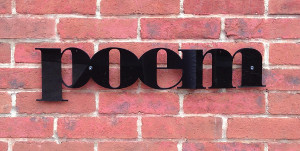
Where does
the River of Words project fit in
here? Given that the project is a series of public texts, challenging because such texts make their own arguments
about the community, its identity, and origins. Moreover, it is a collision
point between understandings of neighborhood identity that place value and
importance on resident activity and communication or physical spaces and
their appearance.
Moreover,
it is a free speech issue and raises the question, how does one evaluate
private property as a zone of free speech? Does it make the public private? To
better understand the controversy, and River
of Words’ importance in residents and word hosts’ lives, I will be
conducting a series of oral history interviews during the month of February,
publishing the audio and transcripts. Stay tuned.
Wednesday, February 4, 2015
Visual Methodologies and the Cathedral of Learning as Institutional Space
I find myself in the middle of a three week series of readings on visual methodologies with my Rhetoric and Culture class, in which we slowly plod through Gillian Rose's chapters on compositional, semiotic, and discursive analysis of images themselves, and discursive analysis of images' location within institutional apparatuses. We also read Cara Finnegan's excellent essay on the naturalistic enthymeme and the skull controversy to contextualize what a close, historically located reading might look like that enacts a kind of discourse analysis from a rhetorical perspective. Next week we wrap up by discussing ethnographic practice and field note writing.
Of course, when thinking about the image as a rhetorical process, rather than an ossified product, no one method will do. How is it that one approaches an object, perhaps an image, or an event, or a text, and reads it in a way that reveals its significance without flattening it or smashing its rough edges? How do you make an argument that is revealing, but not too polemical?
It is here that I find Rose's text especially helpful. She describes the process of analyzing the discursive formation in which an object/text/image/event is imbued as something like a concentric process, polishing and addressing the immediately visible components of the object (trying one's best to remember that what they 'see' and don't see is as historically condition and accreted as the object itself) and then from their seeks out the different modalities of address and analysis that formed a historical fabric around the object. In Finnegan's text this was the image of a cow skull taken during the Great Depression, its visual elements, the other trial images that Rothstein captured, the institution for which he was taking photos, the exigency that brought into being that institution, and then the major political and social events that provided the immediate context for the controversy (gasp! he moved the skull from its initial location) including Roosevelt's election, conservative frustration with government spending, and the tapestry of media response including articles, letters to the editor, as well as more private dialogues (communication between Rothstein and his director). So already, here, we have a rich contextualization of the object, both historically and socially. But more is needed. Finnegan then draws on the history of photography and assumptions (as well contradictions) about its realism, pointing to data about how the "mechanical eye" is not at all the same as the physical eye, and yet, the photograph is still believed to be an echo or index of the real on the level of representation, ontology, and mechanical fact. She then tracked these assumptions, references to the "real" in the contemporaneous debates, exposing how even those refusing the controversy did so within the idiom of photographic realism, or, her phrase, the "naturalistic enthymeme." In this text, Finnegan explores the production of the image in particular, the technology of photography, the characteristics of the image, and its complex audiencing to tell a story about persistent biases and epistemologies surrounding the place of photography in our ocularcentric culture. In so doing, she illuminates that an image is never a static product, but is a constantly evolving and multilayered social process.

To the same ends, I sought to get the students thinking about how our institutional environments are their own discursive formations that produce "truth effects," or, rhetorical understandings of what-is, that are powerful, and also contradictory. Our class, located in a bland room on the third floor of the Cathedral of Learning is flanked by some of the Nationality Rooms, rooms "donated" by Pittsburgh's various ethnic group organizations that replicate the classroom styles of various cultures, across time. For example, a 17th century Welsh schoolhouse. Moreover, the Cathedral itself is a curious ensemble of the sacred and the secular, using gothic style to lend gravitas to the combination of bureaucratic, capitalist, and academic activity taking place in its hallowed (and also over and under heated) halls. So, I asked them to walk around and observe the layout of the 1st and 3rd floors, the architectural flourishes that produce different effects in the audiences, the spatial routing in place to control the movement of visitors, and the modes of display that offer a sense of the nationality rooms.
They came back excited, having gathered evidence in different ways. Some took notes. Others merely observed. And yet others took photos of plaques and inscriptions with their phones. One student mentioned the impact of the idea of the "cathedral" a kind of religious implication that lends gravity to the institution. Another pointed out that the nationality rooms function to create a sense of diversity, that all cultures are accepted and contained in the university, and as such, it is a representation of Pittsburgh in miniature, potentially a synecdochic or metonymic space. A fourth read a plaque commemorating the founding of the cathedral, a place for learning and acceptance. She also pointed to another plaque at the entrance to the great hall on the first floor that it is a place for dreams and aspirations, a claim that is supported by the soaring ceilings and the density of departments suggesting that a diversity of goals are possible. And less savory reactions emerged. The common hall, a student pointed out, was actually a panoptic space, where those sitting and working were intensely conscious of their visibility from above and alongside.
The chairs, although historical and beautiful, in many of the nationality rooms, are uncomfortable and urge the viewer to keep moving, to keep circulating. Taking class in a beautiful but not very functional 17th school house elicits emotions of frustration or disillusionment as one hears the cheery voice of a tour guide gushing about the wonders inside. And the nationality rooms, though homages to the world's cultures, also come with postcards, purchasable oddities, glass display cases telling the visitor "Available in the gift shop!" And so we came into contact with a central contradiction in the institutional heart of the University, a tension between truth effects of learning, the life of the mind, cosmopolitanism and unity, and the ongoing maintenance of these effects through the commodification of cultures, exoticism, and touristic packaging.
Much like the naturalistic enthymeme, which we know to be a construct and yet we still desire and believe in it (think here, perhaps, of the trope of the "I woke up this way" photos wherein one is soothed by images of ostensibly unframed, unmade up women to lessen the pressure of perfection that is brought to bear on feminine bodies by beauty myths and photo shop, and yet, we still seek release and support in the truth of the un-marked image), we live and invest in institutions that are grounded on their own contradictions. Visual methods, at the very least, provide us tools to see the process of construction that makes such institutions seem to generate unproblematic truths. In this sense, it is worth a wander around our own corridors to see with fresh eyes the constraints and possibilities that are just around the corner.
Works Cited:
Rose, Gillian. Visual methodologies: An introduction to researching with visual materials. Sage, 2011.
Finnegan, Cara A. "The Naturalistic Enthymeme and Visual Argument: Photographic Representation in the" Skull Controversy"." Argumentation and advocacy 37, no. 3 (2001): 133.
Of course, when thinking about the image as a rhetorical process, rather than an ossified product, no one method will do. How is it that one approaches an object, perhaps an image, or an event, or a text, and reads it in a way that reveals its significance without flattening it or smashing its rough edges? How do you make an argument that is revealing, but not too polemical?
It is here that I find Rose's text especially helpful. She describes the process of analyzing the discursive formation in which an object/text/image/event is imbued as something like a concentric process, polishing and addressing the immediately visible components of the object (trying one's best to remember that what they 'see' and don't see is as historically condition and accreted as the object itself) and then from their seeks out the different modalities of address and analysis that formed a historical fabric around the object. In Finnegan's text this was the image of a cow skull taken during the Great Depression, its visual elements, the other trial images that Rothstein captured, the institution for which he was taking photos, the exigency that brought into being that institution, and then the major political and social events that provided the immediate context for the controversy (gasp! he moved the skull from its initial location) including Roosevelt's election, conservative frustration with government spending, and the tapestry of media response including articles, letters to the editor, as well as more private dialogues (communication between Rothstein and his director). So already, here, we have a rich contextualization of the object, both historically and socially. But more is needed. Finnegan then draws on the history of photography and assumptions (as well contradictions) about its realism, pointing to data about how the "mechanical eye" is not at all the same as the physical eye, and yet, the photograph is still believed to be an echo or index of the real on the level of representation, ontology, and mechanical fact. She then tracked these assumptions, references to the "real" in the contemporaneous debates, exposing how even those refusing the controversy did so within the idiom of photographic realism, or, her phrase, the "naturalistic enthymeme." In this text, Finnegan explores the production of the image in particular, the technology of photography, the characteristics of the image, and its complex audiencing to tell a story about persistent biases and epistemologies surrounding the place of photography in our ocularcentric culture. In so doing, she illuminates that an image is never a static product, but is a constantly evolving and multilayered social process.

To the same ends, I sought to get the students thinking about how our institutional environments are their own discursive formations that produce "truth effects," or, rhetorical understandings of what-is, that are powerful, and also contradictory. Our class, located in a bland room on the third floor of the Cathedral of Learning is flanked by some of the Nationality Rooms, rooms "donated" by Pittsburgh's various ethnic group organizations that replicate the classroom styles of various cultures, across time. For example, a 17th century Welsh schoolhouse. Moreover, the Cathedral itself is a curious ensemble of the sacred and the secular, using gothic style to lend gravitas to the combination of bureaucratic, capitalist, and academic activity taking place in its hallowed (and also over and under heated) halls. So, I asked them to walk around and observe the layout of the 1st and 3rd floors, the architectural flourishes that produce different effects in the audiences, the spatial routing in place to control the movement of visitors, and the modes of display that offer a sense of the nationality rooms.
They came back excited, having gathered evidence in different ways. Some took notes. Others merely observed. And yet others took photos of plaques and inscriptions with their phones. One student mentioned the impact of the idea of the "cathedral" a kind of religious implication that lends gravity to the institution. Another pointed out that the nationality rooms function to create a sense of diversity, that all cultures are accepted and contained in the university, and as such, it is a representation of Pittsburgh in miniature, potentially a synecdochic or metonymic space. A fourth read a plaque commemorating the founding of the cathedral, a place for learning and acceptance. She also pointed to another plaque at the entrance to the great hall on the first floor that it is a place for dreams and aspirations, a claim that is supported by the soaring ceilings and the density of departments suggesting that a diversity of goals are possible. And less savory reactions emerged. The common hall, a student pointed out, was actually a panoptic space, where those sitting and working were intensely conscious of their visibility from above and alongside.
_-_Pitt_-_IMG_0573.jpg) |
| Commons room. Panoptic space. |
The chairs, although historical and beautiful, in many of the nationality rooms, are uncomfortable and urge the viewer to keep moving, to keep circulating. Taking class in a beautiful but not very functional 17th school house elicits emotions of frustration or disillusionment as one hears the cheery voice of a tour guide gushing about the wonders inside. And the nationality rooms, though homages to the world's cultures, also come with postcards, purchasable oddities, glass display cases telling the visitor "Available in the gift shop!" And so we came into contact with a central contradiction in the institutional heart of the University, a tension between truth effects of learning, the life of the mind, cosmopolitanism and unity, and the ongoing maintenance of these effects through the commodification of cultures, exoticism, and touristic packaging.
Much like the naturalistic enthymeme, which we know to be a construct and yet we still desire and believe in it (think here, perhaps, of the trope of the "I woke up this way" photos wherein one is soothed by images of ostensibly unframed, unmade up women to lessen the pressure of perfection that is brought to bear on feminine bodies by beauty myths and photo shop, and yet, we still seek release and support in the truth of the un-marked image), we live and invest in institutions that are grounded on their own contradictions. Visual methods, at the very least, provide us tools to see the process of construction that makes such institutions seem to generate unproblematic truths. In this sense, it is worth a wander around our own corridors to see with fresh eyes the constraints and possibilities that are just around the corner.
Works Cited:
Rose, Gillian. Visual methodologies: An introduction to researching with visual materials. Sage, 2011.
Finnegan, Cara A. "The Naturalistic Enthymeme and Visual Argument: Photographic Representation in the" Skull Controversy"." Argumentation and advocacy 37, no. 3 (2001): 133.
Subscribe to:
Posts (Atom)