Wednesday, April 22, 2015

River of Words Oral History Project: Randi Marshak, "Balloon"

CB: OK so I am here with Randi Marshak as part of the River of Words Oral History Project. The date is March 22, 2015. So thanks for your time and being here, I know that the weekends are precious.

RM: No problem.

CB: So, I wanted to start with some demographic information, I am interested in getting a sense of the diversity of participants. So if you could give me your name, your address, your age, the race you identify with and your marital status.

RM: OK. OK, so my name is Randi Marshak. I live at 406 N Taylor Ave, Pittsburgh, PA, I am 53 and I am white and I am married.

CB: Does your house fall within the city historic district?

RM: Yes. It's across the street.

CB: My understanding is that the historic district is not always, um, spatially coterminous. 

RM: Yeah, because I don't think this [City of Asylum office] is.

CB: How long have you lived in the North Side?

RM: 15 years.

CB: And how long have you lived in Pittsburgh?

RM: Let's see. About 20.

CB: Great. So let's turn to the River of Words project. Can you tell me about how you got involved, and what that experience was like for you?

RM: Well, so, I know of City of Asylum, because I live across the street, or, my garage is across the street and we are on Taylor at the front of the house. So, I always like to support them, and I think I was at a concert down the street and then they had the words, and I just asked what it was about, they told me, and you know, I always like to support them, and anything that can be community-wise...I was on the Central North Side Community Board too, and one of our...I was involved in the Community Plan, and part of it supports public art in our community, in the Central North Side, so I wanted to support that.

CB: What word did you choose.

RM: I chose balloon.

CB: That's interesting. Why "balloon"?

RM: Well, when the words were up I saw a lot of them were in foreign languages, and unfortunately, at the time I missed it, the way it was set up, I didn't know that translations, and I wanted to pick a word that I knew what I meant. I picked another world at first but then I thought "balloon" was more fun and you know, uplifting, balloon.

CB: Its very whimsical.

RM: Yeah, so that's why I chose it.

CB: Did having this word on your house, did it create any new interactions, or conversations, or stories?

RM: Um, you know, so many people around here are familiar with the project, so I can't say that I met anybody new because of the word, I did have some out of town friends who were like "What is this? Why do you have balloon on your window?" And then I explained what it was and then when we were walking around the neighborhood they were like, "Oh look! There's one, there's one," you know? And it was fun to see that.

CB: So what do you think the significance of this project is?

RM: Hmm. I think it's just a nice way the community can express its uniqueness and its support for the City of Asylum and for public art. It became very popular. Even people who missed out wanted to be involved and I noticed that accross the street people just put up their own words, like the garage right across the street [from City of Asylum]. 

CB: Oh, that's not part of the project? I didn't know that. That's funny.

RM: I don't think so.

CB: Funny. I was seeing it when I was kind of pacing around between interviews and I was like "Oh ok, garages, cool." 

RM: I think they put up their own words, and I know of other people who kind of missed out and put up their own words.

CB: Cool. So it's been over six months now, has the meaning of the word changed at all for you?

RM: Um, no, I don't think so. I think sort of that uplifting thing. When I walk by, or drive by, and see other words its funny, like, the one is "Fly," and the way they kind of did it in script its fun...and then you walk by other and are like "Ooh, I wouldnt've picked that, 'emptiness'...I wouldn't want that!" and so its just interesting the way some of them affect you. And then I've gone, when I've passed words that are in other languages I will use my cell phone and try to get the translation.

CB: Sort of like, I don't know, re-mapping or re-understanding the neighborhood. That's really cool.

RM: Yeah.

CB: OK. So let's turn to the Historic Review Commission conversations that are happening now. How much of it are you sort of aware of and do you have any thoughts on what the HRC should do?

RM: Yeah, I am aware of it. And I think they should just leave it alone. They're removable [the words] and they are not severely changing the facades of homes, which is the basic thing with the HRC, that the facade should stay historic. So, just, adding a flowerbox, adding an amenity, and its nothing that can't be removed, or is really taking away from the historic facade. So, yeah, I think they need to back off. [Laughs]

CB: So the last question I have is about the role of public art in the north side and in Pittsburgh, so can you tell me what you believe to be the purpose of public art in this neighborhood. Who does it serve and what does it produce or create?

RM: Well, I think that public art is an amenity. It can bring up a neighborhood. It gives people something to be proud of in their neighborhood. Just like litter can bring down a neighborhood I think public art can bring it up.

CB: Is there anything else you would like to say about River of Words or about public art that I haven't given you a chance to talk about, or about your word in particular?

RM: No, I'm just happy its here. I hope it can stay for as long as people want. I think it was very well done which is why it was so well supported and it was nice that, I didn't think that there was going to be...I thought they'd [the artists] put up the words but I didn't realize that all the words were going to be different colors, different materials and different script, and I think that really added to the project.

CB: Alright, cool. Thank you so much for your time.


RM: You're welcome!

Monday, April 20, 2015

Style Publics: Translatability of Graffiti Text

As I work on revising the dissertation into a manuscript, I am beginning with the chapter on Chicago's Meeting of Styles festival. This chapter, to me, feels the most intimate, because I spent the most time in this city and got to know the graffiti writer community fairly well, but also is the most difficult to translate insights outwards.

The revised version will be an exploration of the different kinds of publics brought into being and enacted at the festival (I suggest there are seven) and a reflection on the insights this provides scholars in communication and cultural studies about the possibility of shaping new worlds through the instantiation of public discourses (or images, or performances, etc.)

To that end I am revisiting Michael Warner's critical text, Publics and Counterpublics (2005) in order write about two kinds of publics: ethnic publics and styles publics.

Style, in the chapter "Styles of Intellectual Publics" refers to (largely academic) writing styles, and contemporary debates about the "nature and the duties of the intellectual" (129). Writing, in this context, is not just descriptive, but rather, it is about "how, by what rhetoric, one might bring a public into being when extant modes of address and intelligibility seem themselves to be a problem." (130) Or, how does one write towards a future.

This question, for Warner, is paradoxical, because one's writer is neither free of discursive histories, but also, if it attempts to exceed the "usual frame of reference, teaching us to see or think in new way, [it] can be a necessary means to a more just world," and yet, "to the degree that our commonsense perceptions contain distortion, just so far will the effort of reimagining seem difficult, even (to many) unclear." (133) On the one hand, if a work is fully intelligible to a population, it likely does not challenge or question existing understandings of the world, but it if is opaque, it may be so because it challenges the given.

A further fallacy that Warner points out is the idea that broad reception is evidence of effective communication, the idea that "the wider it [a style] circulates, the better it must be" a "false aesthetic of transparency" that "has a powerful social effect...it will naturally privilege the majority over less familiar views." (135) The idea that "a public intellectual is one who writes for large numbers" appeals to a "headline temporality" that erases "the mediation of publics; genres; modes of address; the circulation of cultural forms; ways of reading, including affect; and the social imaginaries that are the background of literate practice." (143) This isn't to say that anything that is complex is necessarily resistant, but it does call into question the commonplace invoked about the normative value of transparency and readability linked up to the occupation of the public intellectual. Warner notes:

"Accessible prose alone gets you nothing, if the ideas are unpalatable for other reasons, or if the public is structured in such a way as to be substantively prejudicial. There are many arguments that will never find their way to the pages of the New York Times no matter how clearly expressed. Just as it is a mistake to equate good writing with accessibility, so also is it a mistake to equate an easy style with effectiveness." (141)

The elements of this argument may start, here, to sound familiar to the graffiti writer, who is charged often with producing "incomprehensible" or "unreadable" texts, thus alienating a potentially supportive public. But must this be the case? Is this the whole story? The act of writing, offering a particular idea and intervention in physical public space, is a form of occupying and transforming urban spaces in ways that challenge the presumed neutrality of public space. Such texts are unpalatable not because they are unreadable but because they are there. They index a style of marking and shaping public space that is personal, and critical. It is not for everyone in the same way. By understanding graffiti as a politics of style that is not always reducible to a claim and a warrant challenges a model of reading the public sphere as simple reason-giving. Instead, the public, and style publics operate through "uptake, citation, and recharacterization." (145).

One could say that graffiti style, too, circulates through uptake, citation, and recharacterization, remixed and resituated to suit its place of installation, indelibly impacted by the technologies and histories that precede it. At Meeting of Styles (an apt title) styles encounter one another, creating a conversation that is not about specific actions, but rather a visualization of a transnational art community as it is instantiated in a local space. In the grey-area that MOS occupies: neither illegal, nor officially commissioned, it also occupies a grey area with respect to readability and legibility: not all texts are transparent, some deliberately so, and yet others are, offering glimpses to the outsider of the complex discussions and evolutions contained within a style.

Warner notes: "World making projects require not just intentions, or the moralized postures that are called 'having politics,' but a set of forms that can articulate the temporality and social space of their circulation." (151) Here we arrive at the capacity that style, and the meeting of styles, has as a resource for cultivating new publics, by generating a set of forms that can support the history and sociality of their production. From wildstyle to three-dimensional burners, these styles are imprints of transnational journeys and localized inscriptions, they speak to sociality and competition, about being outsiders or/and being excessively on display, the possibility for communication on and around urban surfaces, but also their forgetting.

It is also in this scene, the Meeting of Styles, that we mark a journey from Diego Rivera's polemicism. Instead, at the festival, participants are committed to the engagement of an alongside different styles, putting one's own style into question as spatially and socially relative, as Haste elaborated in 2011, "You break away from your town." It provincializes one's own style. In this sense, the ethic of stylistic encounter resonates with Foucault's reflections on polemic, narrated by Michael Warner. Foucault notes:

"In the serious play of questions and answers, in the work of reciprocal elucidation, the rights of each person are in some sense immanent in the discussion. They depend only on the dialogue situation....the polemicist, on the other hand, proceeds encased in privileges that he possesses in advance and will never agree to question. On principal, he possesses rights authorizing him to wage war and making that struggle a just undertaking; the person he confronts is not a partner in the search for truth, but an adversary, an enemy, who is wrong...whose very existence constitutes a threat. For him, then, the game consists not of recognizing this person as a subject having the right to speak but of abolishing him, as interlocutor, from any possible dialogue." (152)

This is why I am drawn to these grey-area scenes of legal graffiti. They are subjunctive spaces wherein the purity of the form is put into question in ways that recognize other players as potential interlocutors, not adversaries. Warner suggests that Foucault stops short of "describing intellectual work as a kind of counterpublic." (158) Does the term "counterpublic" here simply mean "alternative" or "reflexive" or "questioning"? Is it the previously mentioned terms, combined with an interest in conditions of circulation and mediation? Why might the term "public" or "public - plus- adjective" fail?

Perhaps, but most important in Warner's treatment, is the complexity of temporality that emerges in Foucault's orientation to intellectual work as more than polemic. It is "multi-leveled temporality" a "way of recovering the orientation to futurity" that is not dependent on "headline temporality"but instead situates intellectual inquiry as the zone by which one can "image a speech for which there is yet no scene, and a scene for which there is no speech." (158)

I argue in the Meeting of Styles Mexico chapter that it is precisely the subjunctive tense of the festival that allows writers to reimagine public space in plural ways, apart from state-based nationalism but also not in explicit opposition to it. In a similar way, in Chicago, Meeting of Styles aggregates populations who consider the city of Chicago to have the possibility to be otherwise, not in the language of rupture or revolution, but of style. An encounter between a variety of styles. In this scene, not all texts need to be transparent, and not all audiences need to be hard-line supporters. By remaining slightly opaque graffiti offers a rewriting of urban space and urban imaginaries that may not yet have found there scene, but, it is this possible impossibility that keeps such style publics moving, creating, evolving towards an unknown future.

Friday, April 3, 2015

Graffiti Education: Writers as Educators, Urban Visual Cultures Virtual Graffiti Roundtable (WERM, FLASH, TRIXTER)

I write this post a week or so late, as is appropriate, since it feels Spring semester that Time runs several miles ahead of me, in every instance.

In my Rhetoric and Culture course, which is focused on public art, we have discussed visual methodologies, spatial segregation and control, site specificity, monuments and official discourse, muralism and vernacular rhetoric, graffiti and the social production of criminality, street art and the classed and raced approaches to proper and improper public art, and public protest as performance art. Last week we had virtual speakers, Chicago based writers, educators, and graffiti historians Werm One, Trixter Feds, and Flash of the ABC crew. Either making contact through face time; conference call; or a facebook chat, these brilliant folks fielded questions from my students, and offered their own insights on the history and representation of graffiti in Chicago.


We first got a hold of Trixter. He introduced himself as a Chicago writer who got into the scene from being a b-boy. He described the history of contact between New York and Chicago graffiti. He has been a bboy for 35 years, entering the scene as part of the "burgeoning hip hop movement in the early 80s and so he represents that experience." He was one of the original developers and pioneers of graffiti style in Chicago in the 90s.

1985: Trixter, on Blue Line by Logan Square. http://www.artisticbombingcrew.com/photos.asp?artist=6&type=2

 The first student asked what he thought about graffiti being described as egotistical, or selfish. He answered:

Is it selfish to express yourself? For the voiceless who is un answered and uncounted? People are not aware of the fact that graffiti, which seems to have an idiosyncratic persistence, has persisted for a reason. The need and desire to be heard.

Another student asked about what happens to graffiti when it gets placed in the gallery:

In a gallery context it is a patron appreciating the art form. It is distinct from the internal perspective of the writers, the practitioner side. Graffiti [comes before] the hip hop movement, it is one of the most primal forms of writing. There are debates about large scale murals and productions, a debate about keeping it real and true to its origins, that sometimes it becomes much too commerical. My take on legal graffiti is that there is a need for public space. Graffiti is always commercialized, but if you want to stay true, that is the artist's prerogative. But there is a lack of education [about graffiti culture] so what I am working to do is make it so that there is greater awareness and education about graffiti in the larger population. Graffiti [speaks to] a macroscale, a history passed down through generations.

Another asked about the distinction between graffiti and street art:

To me, it seems that the difference is what attracts the viewer to the object to be seen and recognized. So the basis for when people say something is graffiti, or something is street art, it is more about the image or the text, like Mickey Mouse or Donald duck..."graffiti" is not the original word. That is the label society attached to our practice, it means "scratches and scrawling" what what we do is writing, with paint and material and ink. Graffiti is writing, the symbolic, while street art is more about scenery, background, characters...scenes in the street. The issue with graffiti is writing.

Trixter left the students with a last, powerful thought:

The number one thing that you must know, about graffiti and illegality, to think about in considering graffiti and writing and public space, is that graffiti precedes property ownership. Graffiti precedes property ownership. There have been different aspects of writing for thousands of years...It has been scientifically verified that graffiti is the oldest form of art...where people would spray a color medium through the mouth onto the wall. It is the nature of man to leave markings.

We next talked to Werm, who called from his car, propping the phone on this wheel such that it spun around while we talked. I held the phone up like a microphone, plugging the sound into the stereo, and Werm explained that he wrote with CAB crew, has been writing for decades, and now makes a living as a professional artist. Students asked about whether he thinks that it is bad to do graffiti as a kind of commercial art, and he explained that he is able to do it as both art, and livelihood. He remarked that the legal side was nice because you can interact with people, see the enjoyment your work gives them. He explained that his main clients were people who wanted custom rooms painted; cars airbrushed; or t shirts at kids' parties. A student asked about whether his family did not like that he was a writer. He reflected, noting that his shift to a more legal realm allowed for him to integrate family and work, "they are proud of me," he reflected, and he noted that he has taught many of his kids to paint. He also explained for the students the reason for tagging-- that it is a form of fame, but also, of practicing, it is the practice that enables one to get the skills to do incredible lettering or image based work, such as the 15-foot-jesus he produced in a recent mural. He rapped from one of his songs: "Started out a toy but the kid had heart," he started out unskilled but with determination, hard work, and practice, he developed his skill set.


Last but not least we facebook chatted with Flash, who greeted us wearing a helmet covered in graffiti. He is an engineer at Rydell Sports, and so it was a funny but powerful way of demonstrating the linkage he makes between graffiti worlds and work and family life.

He first explained to the students his history. He started painting in 1983, after he saw the movie "Wild Style," and painted the Blue Line in Chicago. ABC was among the first crews to apint on roof tops, and the first generation that learned about history in Chicago. He documented everything during that period, gaining the nickname "Flash". In 1987 he was arrested and given a choice: either the military, or jail.

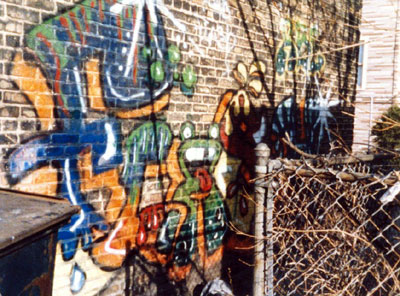
1984: Flash, "Seen." http://www.artisticbombingcrew.com/photos.asp?artist=5&type=2

After serving in the military, Flash became a mechanical engineer for Rydell Sports. 12 years ago he returned to the graff scene, and started the ABC website, which he curates, and gave us a guided tour through.

With my computer facing the screen so that Flash could guide me, he narrated a tour through the ABC (Artistic Bombing Crew) website, a dense archive and platform for photographs and discussions about Chicago's graffiti past and present.

Graffiti has been harshly prosecuted in Chicago, he noted, and Alderman Richard Mel took the ban on spraypaint to hte Supreme Court, making Chicago one of the first cities to have a ban on spraypaint. As a result, graffiti was quashed in the North Side from 1987 to 2003.

When Flash returned to the graffiti scene, due to the hostile climate for graffiti, he also began to search of spaces for legal productions, which mark the beginnings of Project Logan, a wall at Fullerton and Milwaukee that Flash curates, with the permission from the Logan Square alderman. The wall is in a coveted location, next to the Blue Line which connects Chicago from East to West, and is ridden by over 80,000 people, meaning, in Flash's opinion, that likely 50,000 plus people will see the wall.
Project Logan view from Train. June 2013. http://www.chicagograffiti.com/forums/topic.asp?TOPIC_ID=4389&whichpage=2
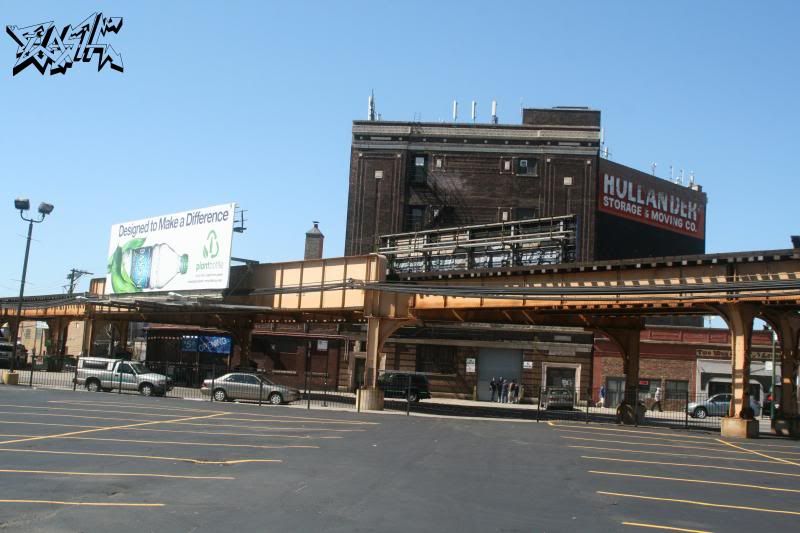
 The wall is in constant rotation of work, and is divided into three sections: Artist, Crew, Bombers (evoking Flash's Crew name, ABC, Artistic Bombing Crew). The bomber section is for letter based productions and rotates every two weeks. The Artist section includes graffiti murals, mixing text and imagery, and stays up for about a month. Crew walls include collaborative, crew based productions. The wall is by Hollander, a historic site for graffiti productions.

View from Project Logan Wall. http://www.chicagograffiti.com/forums/topic.asp?TOPIC_ID=4389

Logan Square, he explained to my students, is a neighborhood that played a key role in Chicago's graffiti history. Between 1983 and 1987 writers held meetings at the Eagle.
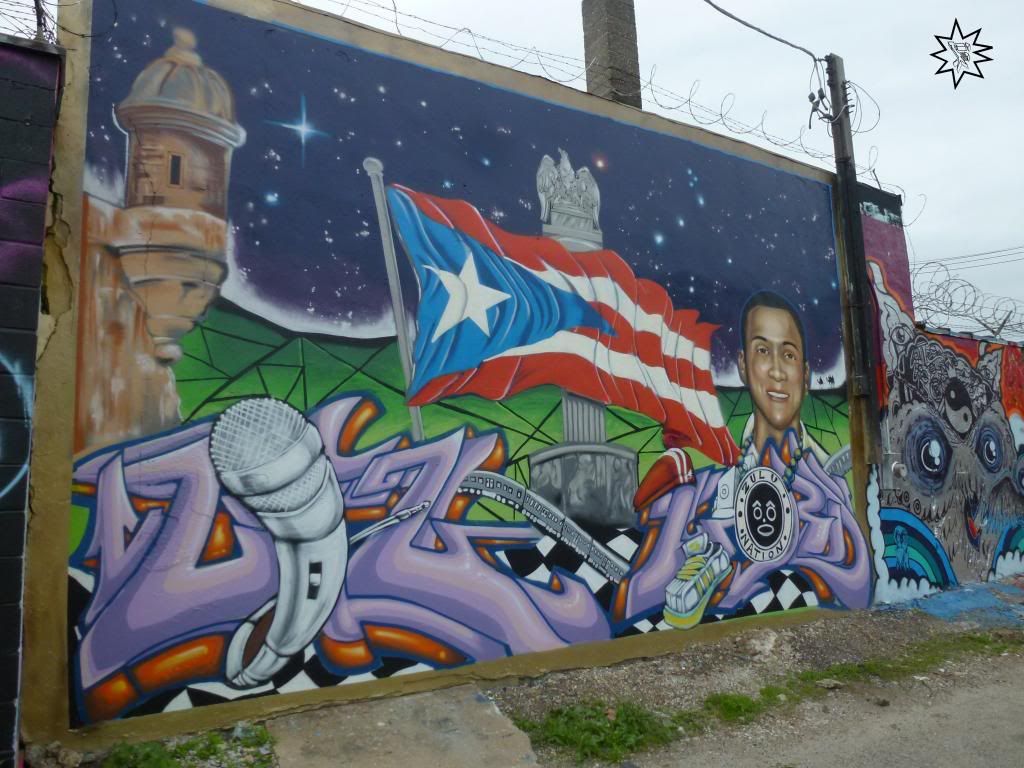
Project Logan. 2014. http://www.chicagograffiti.com/forums/topic.asp?TOPIC_ID=4389&whichpage=2

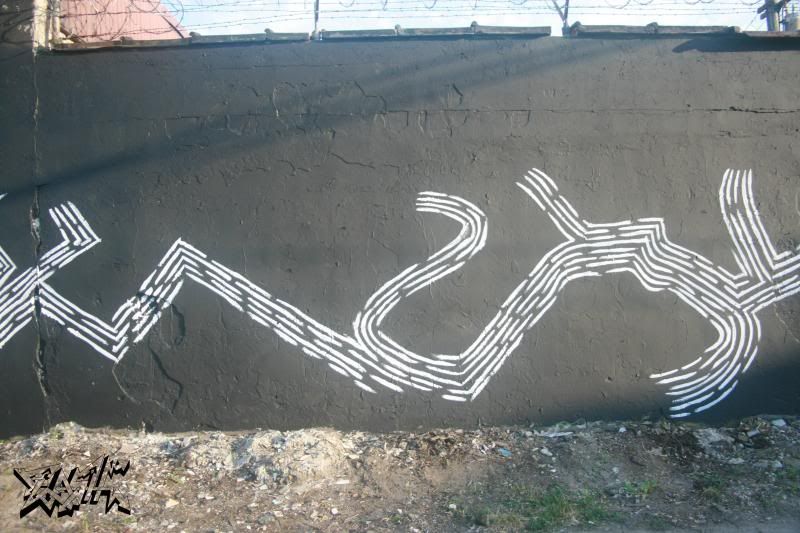
One of the artists who first was put on the Project Logal wall, KLTA (Keith Lawrence Turner Alexander) was, according to Flash, Chicago's first street artist: he used brush and paint to create line drawings, white on black on Chicago's rooftops.
KLTA. 2013. Project Logan. http://www.chicagograffiti.com/forums/topic.asp?TOPIC_ID=4389
Graffiti, Flash argued, is for the masses. However, it has also been commodified and commercialized by the mass market, evident in video games with writers and ludicrous shows like Street Art Throwdown. "How do you control something in a free society?" he mused. He also explained that there is a new generation that still works illegally, each generation has its own subculture, and as part of this one, freight and train bombing.

One of my students asked Flash if graffiti gets its impetus from the thrill of doing illegal work, and she asked if less artists would do it if it was legal. Flash responded that there is always a legal and an illegal side, and that some artists go into graphic design. "There will always be more [writers practicing] the vandalism side, but they [illegal bombers] stay in the game longer now." He also marked that there is a difference between permission graffiti, street artists, and bombers.

Another student observed that Flash breaks all the stereotypes about writers being angry, young, criminal, secretive, thoughtless vandals. He has a family, he is employed, and he works with communities. "How do you feel about these stereotypes?" she asked him.

Flash sighed. He explained that the art form contributes to urban growth. "Anywhere a graffiti or permission wall grows up, an art district grows out of it. I see my rent going up: Since I put up the wall in Logan Square my rent is $200 more a month. Seeing graffiti as vandalism is about broken window theory, but when graffiti is seen as an art form the neighborhood improves."

Here Flash marks both the fallacy of broken windows theory, but also the perils of recognition. Graffiti is seen as alluring, but this allure creates neighborhood buzz that makes higher income brackets move in and rachet up rent costs.

He also reflected on the continuation of illegal graffiti, contextualizing it to demonstrate that graffiti isn't a priori disregard for property or "community", it is a result of social conditions of marginalization and neglect. "In Chicago there are a lot of schools being shut down, Chicago Public Schools, and so these kids have nothing to do, they go [and write on the buildings] you can see it on Flikr...almost fifty schools were closed."

Finally, a student asked him what he thought about yarn bombing, and the racialized and gendered politics of its adulation in the press versus the stigmatization of graffiti. "I sometimes want to light it on fire," he laughed, echoing that he has had to fight, for years, to get some legal space for graffiti, whereas yarn bombing, which is illegal, is not prosecuted at all, a kind of bourgeois aesthetic.

At the end of class I always have students fill out a discussion journal page, asking what they said, heard, and learned from the combination of reading and discussion. This week they were especially excited. One noted:

 "I loved everything our guest speakers had to say! Each brought his own view to the debates over graffiti. Trixter made the point that even the term graffiti was assigned by society and that writing public spaces precedes property ownership. In this way, he solidified and supported my views of graffiti as street art...I also loved werm's view's on professionalism. It seems as though the difference between graffiti and street art is payment and permission."

Another wrote: "Flash also said that he did not consider his work graffiti, he considered it art. this was a contrast from how graffiti is often talked about in popular culture...these writers we spoke to very much considered themselves public artists."

And another: "I really liked when Werm talked about his art of a 15 foot Jesus. He was most proud of creating something that a mass audience can enjoy. This surprised me because I always viewed graffiti as art that is more personal to the artist and not meant to be understood by others. I was very impressed by Werm's perspective on this...Trixter's take on graffiti as not vandalizing but rather important for letting your voice be heard was very interesting to me. He explained how graffiti focuses on words as a symbolic figure."

And another: "These artists call themselves WRITERS not scratchers. After speaking with Werm I was totally in agreement about street art being something of a vernacular art, done by a community, for the community...Flash really focuses on teaching people about the history of ABC and their culture...the fact that he breaks all of the stereotypes that usually gets associated with these types of artists is just so eye opening."

These comments are significant. The majority of these students have had little to no personal contact with graffiti culture, they only know of it how its been represented in media and film (largely negative representations). Many are from smaller towns in middle Pennsylvania, mini-cities that are largely homogenous, and largely white. A very few are from Philadelphia and a few from Pittsburgh. Only a few are from out of state. The comments show that the public can and should be educated about graffiti, graffiti literacy needs to be promoted as a way to foster greater understanding of the social motivations and nuanced style that informs this art movement.

A hearty thanks to the writers for their time and brilliant expertise, and to the students for their thoughtful questions (and help managing technology).