Thursday, January 13, 2011

“Sarah Palin, Jared Lee Loughner, Gabrielle Giffords, and Vitriol: Emotions and Democracy”


The tragic shooting of Gabrielle Giffords, and murder of John Roll and five others, on January 8th has triggered what Carl Hulse and Kate Zernike term a “wrenching debate over anger and violence in American politics.” Hulse and Zernike suggest that “inflammatory language, threats and implicit instigations to violence have become a steady undercurrent in the nation’s political culture” and a National Public Radio stream suggested that Loughner’s website, as well as Sarah Palin’s facebook page, functions as evidence of these violent tendencies.
“Vitriol” and “anger” have become hegemonic terms in the last few days, with Arizona being its spatial metonym. However, this raises the question, are terms like words “vitriol” and “whack job” and “zealots” and “ultra-conservatives” productive terms to map out a phenomenon that might be indicative of something more than party politics? Is the concern about vitriol or is it a much longer lasting anxiety about the relationship between emotionality and reason?
An easy way to address this issue might be to say that national discourse is becoming increasingly hysterical and that we should move back towards language rooted in cool rationality. A trickier reading strategy could be to acknowledge that “vitriol” is just one of a range of emotions, and “media websites” like Palin’s facebook profile and Loughner’s website are not causes for violence but rather expressions of already held sentiments. It would necessitate taking emotion seriously as an inevitable and important aspect of politics (and reasoning) and avoiding labels like “zealot” and “crazy” that exile those persons from the realm of political discourse, putting them outside of reason and outside any sphere for relevance.
In the Ethics, Spinoza deals with a similar fallacy as our contemporary vitriol-scare: that emotions are defects of human nature. As a corrective Spinoza argues that emotion is part of being a living being with a body, and is not normatively good or evil, only good or bad based on the kinds of actions produced. This insight is instructive for us: instead of condemning “vitriol” as an a-priori demon we must contextualize it within a range of other emotions, think about which emotions receive public uptake , and consider whether or not such emotions can be channeled into productive actions at all. Emotion is an inevitable part of political discourse that needs to be a legitimate matter of public discussion, not an id-like form that ghosts the margins of our collective consciousness.

See http://www.nytimes.com/2011/01/09/us/politics/09capital.html?_r=1&hp
“Don’t Get Demoralized! Get Organized! Take Back the 20!” http://www.facebook.com/note.php?note_id=373854973434&id=24718773587
See Baruch Spinoza, Ethics: Treatise on the Emendation of the Intellect, Part Three. Hackett: 1991, p. 102.
Ibid p. 104. Emotion for Spinoza is an “affectation of the body by which the body’s power of activity is increased or diminished, assisted or checked, together with the ideas of these affectations.”
See Victoria Henderson

Friday, June 18, 2010

Spectacles' Interiors: the Comedy of Errors from the Soundbooth


Last weekend I was home in Inwood, Manhattan, for a few days before a conference trip.
Visiting during theater season inevitably includes watching the plays, being an extraordinarily energetic audience member, and helping to pack up the sound, lights, and set equipment (really only a little bit, since my mother, the technical director, has superb help from two fabulous interns, names and affiliations listed on the Moosehall website www.moosehallisf.org). While most of the public art objects I analyze are those that are surprising, ephemeral alterations to the urban environment, the Moose plays are annual productions that I have worked on, watched, and publicized on and off for the last ten years. So I want to use this as an opportunity to think about performances that are based on repetition, habit, and constructing rather than disrupting urban space. The summer festival as an expected event builds a public cumulatively, through networks of actor affiliations (in the last ten years since my parents incorporated the company there have been core sets of actors I have essentially grown up with), media texts (Manhattan Times, the New York Times, among others), government contacts (changing and developing relations with the alderman's bureau, national cultural associations, and the New York City Parks Department), and finally audience members' attachments and publicization.

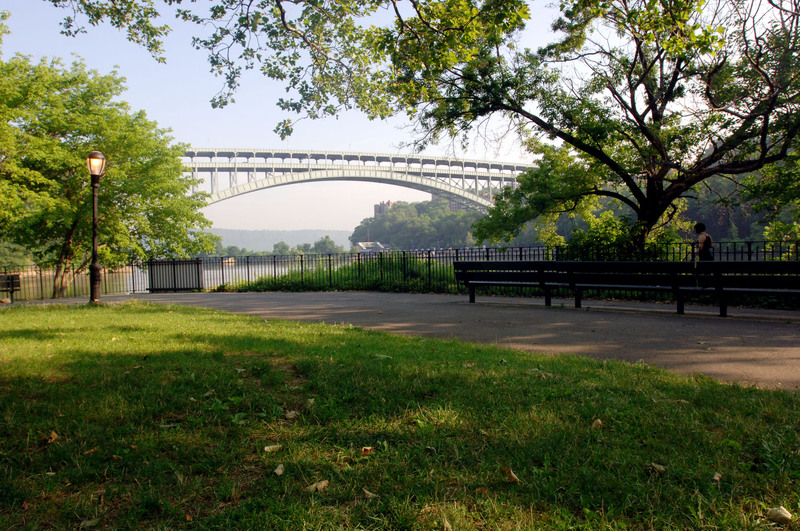
The Inwood Shakespeare Festival began in Inwood in in 2000, with Twelfth Night and was incorporated in 2001, by Ted Minos, as the Moose Hall Theater Company. Each season, stretching from early June to late July, there is one Shakespeare production, one adaptation of a popular text, a children's concert, and sometimes an opera. The Shakespeare and the adaptation each run about twelve shows each, weather permitting, in the same location in Inwood Hill Park: on the tip of the peninsula where the Sputyen Duyvil flows into a marsh, around a man-made stretch of fields, and an existent set of woodlands (the only natural park in Manhattan). The park has two large baseball fields, one medium sized diamond on the peninsula, and then a much larger one between Isham Road and 215th Street, which contains four diamonds, a soccer field, a dog run, a nature center, a basketball court and tennis court, two open picnic fields and a playground (currently under construction). The action of the plays takes place between a stand of trees that point towards the New Jersey bridge, and is interrupted by the horn of Amtrak trains, weather helicopters, motor boats, and raucous shouts from little league and minor league games, outdoor parties and illegal barbeques, neighborhood winos, and pickup games of all sorts.

The park is a cacophonous series of interactions, scenes, and encounters that are repeated, staged, and ritualized over the course of the summer, performances in their own right. The aural texture of Inwood Hill Park: Spanish pop blasting from cars, a seemingly endless series of birthdays with infinite balloon shreds, feasts that inspire spontaneous dancing, is one that I missed when I lived in Evanston, Illinois during my undergraduate years. The streets and many parks were places for fairly limited and singular uses: walking, taking toddlers, and quiet picnics. In Inwood, for better or worse, social activities that might be deemed private, elongated conversations from car windows, for example, occur in the space of the street and the park. Different uses of the park generate conflicts: the folks who live facing the front of the park, my childhood building, constantly hear the noises that can go on until late at night, and so they have an interest in curtailing the amount of time large gatherings can take place. Folks who live facing the back of the building do not have those same concerns. While visitors who come exclusively for the plays want the park to be a space of quiet, for soccer players, baseball players, and outdoor partyers this is not the case.

So I am thinking less about the precise content of the play, rather than the framework of social interactions, warm affiliations, and conflicts that the spatial demands for the play generates. Interning during undergrad concern about how to manage audience seating, keeping aisles clear for sword fights and running exits, was a constant concern. When I returned last weekend signs emerged that delineated where lawn chairs could and could not be (so as not to obstruct the view of picnicers), caution tape, marking off the space for the play had proliferated to encompass the entire rectangle of the middle section of the peninsula, and instead of driving out in a Kia minivan all of the sound tech, light equipment, costumes and props, the company now has a metal storage container adjacent to the performance site, giving what used to be a marginal company a permanent spatial presence, as part of the architecture (and recognized authority) of New York City Parks' Department aesthetic design. The ISF (Inwood Shakespeare Festival) becoming a repeated and expected event has produced new meanings for the park space that used to be used just for parties, pick-up games, dog walks, and jogging. It is now coded as a space of culture precisely for the public.

Habitual performances create a space for people to relax, be entertained, and spend time with neighbors they might not otherwise have time to interact with. It is not a sappy experience of total unity and sudden recognition but merely spending the same time (of the play) and place (of the park lawn) cooperatively that creates I think kinesthetic recognition. Eating outside, in common with actors often as a gimmick partaking in picnics that are ongoing throughout the play, brings "private" activities into a clearly public realm combining affective, intellectual and cultural sustenance with physical nourishment.

Art historian Miwon Kwon reminds us of the importance of site-specificity when thinking about public arts: that it is intimately responsive to and borne out of a location, its history, its people. The Moose Hall Theater company is nothing if not site specific. My father lived in Inwood for years before it became a reality but it was with the explicit purpose of produce a type of cultural event that would resonate with, entertain, and bring together a diverse set of multiracial, and middle class populations. He always talks about set design that does not work against but rather draws on and dramatizes the natural environment (the river, the bridge, the striking woodlands), and works on a form of writing that draws on a distinctively irreverent, boisterous, New York kind of humor, reminding us all that Shakespeare was written in a bar, for loud and drunk masses, not tight-lipped, empty-spirited theoreticians.

Finally, there is a political importance to site-specific community performance. It is an opportunity for people to share space in a context where sharing space is frequently done reluctantly (think packed subway car during rush hour), or is costly (sharing cafe space requires making a purchase). Free common dwelling is rare. And it is a kind of civic education-- it is a precious moment where being in a crowd is not an impediment to one's enjoyment, and where the price of admission is not too steep (it is in fact free).

Moose Hall Theater Company along with other artistic not-for-profits in New York are on the ropes, because their funding is being put on hold until the State senate finishes drafting their budget. That process likely will not be complete till mid fall. Many of these organizations are summer endeavors meaning that this new development is frequently a death knell, since they live and die on grants. The fact that cultural resources, crucial for identity formation, community consolidation, and giving many people who have suck-ass jobs in an economy that is in the shitter some kind of entertainment that is not going to cost them anything, are being put on hold for purportedly more important issues is ludicrous. It is essentially a political attempt to render art and culture non-political and trivial. The stakes of this dismissal are high. Whittling down public resources to bare survival: sewage, police, roads (sort of, potholes abound), also hollows out what it means to be a citizen, and literal and imaginative spaces for public culture. Public arts like free theater rigorously maintain the importance of public space, open access, and cultural communication. Leaving them out to dry is a form of complicity with privatized urban space, purely instrumental communication, and a bare bones model of civic life (voting, paying taxes). A bleak picture.

These are just a few thoughts about how non-interruptive public arts that are repeated, expected, and operate with the goal of communicating with a community's place-based identities produce temporary publics, and reshape urban space, and are political tools to contest rapidly eroding opportunities for politics to occur.

Tuesday, June 15, 2010

Resurrecting a "Dead" Object: Bruce Campbell on the Mexican School


Bruce Campbell argues in "Mexican Murals in Times of Crisis", that conflating the Mexican School with all muralism creates a false narrative where it seems like muralism has died altogether since 1940. The Mexican School existed during the period of 1920s-1940s state sponsored muralism primarily led by Diego Rivera, David Alfaro Siqueiros, and José Clemente Orozco. Additionally, it shunts present muralism into the shadow of the Mexican School, eliding any specificity and present-orientedness the works might have by making them seem like mere repetitions of or references to nationalist history. Instead, Campbell suggests that there is a great deal of mural activity occurring in Mexico during "La Crisis", the economic and social frailty that he argues has divided the state from the people from the 1960s to the present. The consequence of this definitional fallacy is not only to condemn contemporary muralism to the shadows, but to reaffirm official and national definitions of culture, ignoring how culture is a tool of local valorization, meaning making, and community formation that can be used oppositionally. Finally, Campbell argues that this hegemony of the Mexican School has contributed to dangerous reading strategies vis a vis murals where we only look at style and content, and not the context (spatially, politically, historically) in which they intervene. This might be read in rhetorical theory as a need to look at the "rhetorical situation" of the mural- to think more expansively about not just the text/speech/art itself but the relationship between its author's strategic intention, the response of the audience, the historical juncture, and the sense of agency (or hope for agency) imbued to the act of producing the mural. When thinking about muralism it is important to remember, Campbell cautions, that nothing is given-- even the space, the public "canvas" where a mural might be placed is up for grabs.


So how do we refuse an instrumentalized, content-based reading of murals that renders them a mere prop for official manipulation (campbell 13)? One move Campbell performs for us is an unmasking of murals' depoliticized, administrative use by official powers. Murals are used as compensatory tools to boost official legitimacy when it has fallen apart by drawing on the ethos of the Mexican Revolution that is metaphorically contained in the priority of the Mexican School.


Thinking about unofficial and non state sanctioned murals raises broader questiosn about leigitimate communicative forms. The economy of prestige and recognition accorded to the Mexican School and its progeny, versus the bastard language of unofficial murals which use the ethic of social value to contest overly economistic assessments and plans for urban space.


Campbell also challenges the hegemony of the Mexican School in defining and reading murals by pluralizing the mural form. He analyzes both graffiti and mantas (mobile murals on cloth) that arise in 1970s Mexico city, during a period of intense privatization, urban renewal, and plans to destroy much shared communal space (vecindad).


Graffiti functions as the most visible mural form during Mexico's crisis, even though it is as a "scandal" (119), not an affirmation of a shared national culture. Occurring particularly in "cinterón de miseria" or, "belts of misery", around the Federal District and its periphery, graffiti spotlights spaces where the urban crisis occurs, at the level of the barrio and the street (120, 122). Graffiti simultaneously promotes a Mexican style, and a form of "anti-nationalist iconoclasm" challenging and updating the Mexican School tradition (122, 125). Instead of direct, argumentative statements, graffiti operates enigmatically, turning the word into an image that is legible to insiders but not to outsiders (125). It is a "sign and referent" for other interventions in marginal city spaces that can scandalize urban readers, making more explicit the marginality of a particular urban locale (132). Campbell argues that efforts to Mexicanize graffiti by selecting phases that will reach Mexican "readers", to "establish Mexican semiotic materials as the foundation of a graffiti aesthetic" functions as a restraint on graffiti's anti-nationalism (125).


Mantas, "murals with feet" are large mobile cloth images that operate through legible, clear demands (136). It challenges the fixed fresco mural form with a reproducible mural, a "militant graphics aesthetic" (159-160), that resignifies public space (ambientación) (160). Unlike murals they are not iconic but paraphrastic, more polemical than narrative (162).


Finally, Campbell uses these alternative mural forms to think about the space of the local. Murals are used to complement informal territorial interventions (squatting) that expand territorial borders, to mark local spaces that are threatened by urban renewal and gentrification, by instead using local markers to "absorb the national" (112). Informal works like mantas and graffiti refuses the kind of recognition that requires depoliticization as the "price of entry" to official discourse (92). Thinking about murals in all kinds of forms as situated in a particular site, time, and social milieu, instead as mere appendages to official pronouncements, "accenting" instead of "filling" space, allows them to become windows into the "off stage" of public discourse" (89-90).


The "Declaration of Immigration" on 18th Street in the Pilsen neighborhood of Chicago, deals with similar issues, reversing local-national power relations, using an alley way to try and reframe official policy using a vernacular visual form. Campbell's reminder about not reducing the mural to its mere content but also thinking about its context, is helpful here. It could be read just as a magnified and fixed manta from many of the immigration rights rallies occurring in Chicago over the last several years, a generic claim. But its specific location on what is considered to be the central business corridor of a neighborhood imminently threatened with gentrification resonates with the interventions launched by local art groups like those in Tepito, Mexico City, contesting both gentrification and gendered constraints on citizenship by finding new and different spaces to make public and political (communal kitchens, vecindads, school walls), not just making a comment but transforming urban space itself. The place of the mural matters-- it is making a clear connection between seemingly abstract national immigration policy, and the intimate realities of Pilsen residents, many of whom are first generation immigrants, with family members across the U.S.- Mexican border. Just as immigration debates are frequently shunted to the level of administration (the claim being made about Arizona's new law is that it is not a change in law merely continued enforcement of already existing police activities), public space in Pilsen is at risk of privatization as property values increase and the city makes repeated interventions to "manage" chaotic street activity, one example being the creation of the new plaza across from the 18th Street Pink Line stop. Campbell marks a similar intervention that occured in 1974 in Tepito, part of the National Institute of Housing'as attempt to control the informal street economy by building condominiums that would destroy the vecindad, and eliminate social value through the depoliticized language of modernist planning-- murals, produced with the tenants association and Arte Acá were used to revalorize the barrio tradition and contest Plan Tepito (90). "Declaration of Immigration" similarly reclaims and universalizes citizenship not just in its substantive claims but by renewing the importance of public space as a place of political action.


Obviously there is more to say about this piece, which I will comment on in future posts, but I raise it as an example of some of the potential areas where Campbell's work could inspire further expansion. At the end of his text he brackets both Chicano and transnational murals, suggesting that its necessary to evaluate local Mexican mural projects on their own terms. Given the rich connection between the concerns facing artists and communities both in the United States, and globally (rights to public space, privatization, exclusionary citizenship practices) wouldn't it be more fruitful to think about the way mural traditions circulate? Given the hegemony the Mexican School has in historical memory, and the way it has become a dead, frozen object, that is reappropriated and circulated instrumentally to further official policy and government legitimacy, attention to inter-textual, unexpected communication and transformation among forms seem necessary? Refusing to trace parallels and resonances across borders runs the risk of reifying the Mexican School as an ossified and hermetically sealed exemplar for murals instead of part of a multiform, complex arsenal of political techné.