Friday, February 7, 2014

Issy les Moulineaux Hip Hop Festival Artmature: Vandal Screening


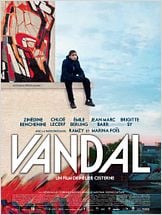
February 4 to 8 marks the Hip Hop Art'Mature Festival  at Issy-les-Moulineaux, just south of Paris. Among the many activities scheduled this week, including sketch competitions, beatmaking, and dance performances, was the screening of Hélier Cisterne's 2013 film, Vandal. Vandal is a coming of age film that explores adolescence, love, and graffiti, situated in Strasbourg. Following Chérif, a youth who is sent to live with his aunt and uncle after an escapade with a stolen car. Part of this move was to avoid jail, instead, Chérif is charged with searching for a stage, an internship. In Strasbourg, he works in construction, first through a preparatory class, and then with his father, who lives in Strasbourg with his new partner.

Chérif, played by Zinedine Bechenine, is hard to read, but even harder to understand. He says little, and communicates with hunched shoulders, a furrowed brow, and pursed lips. Picked on by another stagière he gets into fights but refuses to tell his side of the story. Most of his interactions with adults involve him being yelled at, while he withholds explanations. It turns out that Chérif's studious, well-behaved cousin, Thomas, is a graffiti writer. Thomas brings Chérif into his crew, ORK, initially as a lookout. In one of the most visually arresting scenes in the film ORK bomb an underpass, backlit by highway lights, which cast their shadows against the wall so that they are part of the painting, a quiet, industrial dance of ghosts, animated by the breath-like sound of aerosol can valves. Thomas introduces Chérif to a nocturnal world of expression where conversations play out on rooftops, under bridges, and alongside train cars, intense and uncensored, beneath and outside the reach of adult and bourgeois sensibilities. We also witness a conflict between the bombing style of ORK, and the Siqueiros-like expressionism of another writer, Vandal, whose art work is executed by real-world graffiti artist Lokiss.

While developing as a writer, Chérif becomes romantically involved with his classmate, Elodie, a young woman who (partially) saves him from being jumped and has a fraught relationship with an older brother who is in a gang. Trying to find a place to be alone, Chérif brings Elodie to ORK's secret spot. While painting her leg he is discovered by the crew, and violently ejected from the group, and the world to which he finally has a sense of belonging. Now alone, he follows Vandal, tracking his movements, and using his intelligence to gain entry back into ORK. In a climactic scene, they chase Vandal on a train track, causing him to climb on top of a train where he is electrocuted by the wire overhead.

The rest of the film involves Chérif negotiating his guilt in Vandal's death, and his sense of responsibility to continue Vandal's legacy: he takes on his name, and explores his hiding place, ultimately following the same trajectory up a construction scaffolding on a partially completed building that Vandal has taped in a youtube video, and then writing Vandal's name in a simple yet intense burner.

Assistant scenographer, Nicolas Journet, explained after the screening, that the film is indeed a coming of age film, but that its conclusion does not offer a clear answer as to the direction that the young protagonist's life will take-- rather, it only points to the necessity, the emotional and psychological imperative for expression-- that Chérif carries out in taking up and continuing Vandal's legacy. Graffiti as a narrative device suggests to viewers that it is not the end that is important, but the process, the investment in creation for its own sake.

The production process of the film is fascinating in itself. As mentioned above, Lokiss does the graffiti for Vandal, his work can be found on youtube, and has been involved in the French graffiti scene from its earliest years. The graffiti for ORK is also done by a crew, and represents a more bomber-style form of graffiti, concerned more with plurality than perfection. The film puts into play these dual (and sometimes competing, but also intimately related) tendencies in graffiti culture between repetition and the unique, the need to get up, and the desire for distinction. Moreover, many of the art created for the film is gone, becoming part of graffities legacy as art ephemère, ephemeral. The film takes graffiti and plays with and even modifies dominant tropes, replacing hip hop music, in key scenes, with classical music, notably for those involving Vandal himself, or Chérif echoing his work.

An ethos of openness informed some of the filming, what Journet described as the "magic" of cinema. For instance, in the scene where ORK paints by highway light, their shadows becoming part of the mural, such an aesthetic effect was purely accidental. Such openness was also enabled by the disposition of funders and some of the structures of the French film industry, where subsidization enables filmmakers to pursue aesthetic, cultural, and political interests that may not coincide with the imperatives of the market. However, the film was not fully outside the constraints enforced on graffiti by state and property: some of the struggles in making the film, Journet remarked, mirror the struggles in being a graffiti writer. Crucially, the scene of Vandal's electrocution was not filmed on the SNCF, France's major rail line. SNCF refused to allow filming, partially due to safety concerns, and partially because of the politics (and pejoratives) surrounding graffiti culture. Instead, all train scenes took place on a private line in Strasbourg.

As part of a growing genre, or lineage of graffiti fiction films, used to explore themes of adolescence, love, and belonging, Vandal offers a compelling mediation on what it is to express without communicating, and the cathartic work that writing may do for troubled writers. I must admit that I was profoundly moved by Bechenine's depiction, or channeling, the opacity of a particular kind of adolescent masculinity in revolt, certainly not legible to others, but also not fully intelligible to itself, where the call for explanations, or reason, only reinforces isolation and skepticism if not outright suffering in the face of yet more talk. My younger brother had a tumultuous high school career, one marked by ill thought out escapades, but also, more consistently, dead end arguments in our house that called for reason but more often ended in slammed doors. Watching Chérif's struggle with crushing guilt, one that is unrecognizable as a struggle, and instead mere rancour by his elders, made me wonder what I was missing in my demands for reason and responsibility years ago, but also, what structures can be created in educational systems and family networks that allow for expression without full communication, allowing youth in distress to meditate and incubate.


Moreover, the film points to a less-explored phenomenon of suburban or quasi-urban graffiti, as well as graffiti (and hip hop's) circulation from the United States to Europe. Moreover, it is the product of a urban art milieu where circulation (not only physically, but now, digitally) becomes increasingly critical: although graffiti continues to be an ephemeral art based on traces, its digitality echoes the haunting quality that tags and pieces engender-- they have afterlives beyond that of their makers.

In any case, it offers a thoughtful and emotionally provocative meditation on what it is to find a form of self-expression that does not offer escape from structures of misunderstanding or abrasion, but a more humble but no less powerful tactic of persistence, creation, and holding in reserve, surviving such processes.


Saturday, January 11, 2014

Swoon's "Motherlands": Gallery L.J.

Swoon is a street artist based in Brooklyn, NY, who is world famous for her haunting ephemeral pieces, created using an iconic hand-drawn style, depicting human beings from all walks of life involved in a variety of activities. Her recent show in Paris, titled "Motherlands" and located at Gallery L.J. in Paris' Oberkampf district, offers a compelling transnational exploration of what it is to make a place a home, and how that process necessarily involves community. As such, the exhibit actualizes what affective citizenship, grounded in a feminist ethic of participation, dialogue, and engagement, can look like in spaces that so often take the edge off of street art-- an art genre that is intimately connected to its space of inscription in the street.

Walking down Rue Commines in the bustling 11eme arrondissement, which is full of boutiques, bakeries, and bars, one is struck by the figure of a four meter tall female figure rising from the center of a green, blue, and yellow space, intensely visible through wide glass walls.

 Entering the gallery, I became acquainted with the first figure in the series, called Thalassa, a female figure that is raised from the ground and holds open flowing robes, and also an open chest cavity. The piece is constructed from different kinds of paper, gauche, and string, painted on both sides, and lit from within as well as without by the ceiling lights. With her face raised to the sky and arms connected to the earth by rhizome like root structures, the woman evokes mythologies of Gaia and reclaims narratives about woman's connection to fertility, fecundity, and the earth. The textured green, blue, and yellow wash that colours the gallery space reinforces this naturalistic approach.


The rest of the exposition can be found by walking down a spiral staircase into a basement. The walls are rougher here, and the light is not as bright. Each assemblage of characters is lit from within, and situated within distinct architectural spaces. 


Having grown up in New York, and recently visited Paris' catacombs, I am drawn to histories of urban places where the earth below is used to build visible above-ground landscapes. I noticed in a pairing of three larger figures, putting flourishes on buildings that contain smaller figures that are artisans and workers, that I was confronted by familiar architectures: that of Braddock, Pennsylvania, a former mining town proximate to Pittsburgh.
All three figures work to paint and shape buildings that are in different states of use and disuse. The figure on the left called "Ben," puts the top back on a decaying art-deco building (referencing the spaces of Detroit), while a woman paints what looks like a cathedral.

The figure on the far right, embracing a black structure, the stylized markers of support beams for a tunnel, points to the love due to figures who, in the darkest and most threatening of spaces, gathered the materials that created our cityscapes.

Yet, Swoon also emphasizes the relationship between land, maternity, creativity, and death. In the third room a skeleton embraces a woman while smaller skeletons dance below, birthing more figures of death. Ominous, but beautiful, mortality haunts scenes of life as its intimate counterpart.


The series is made up of work that Swoon has created during the past three years, and draws from the people, spaces, and collective issues that framed her interactions. Moreover, the passing of her own mother in 2013 provides a poignant emotional background to the displays. Her aesthetic, which is based on constituting art that can decay, that grows and also dies in urban spaces, celebrates the beauty that such vulnerability can create. The embodied experience of walking around and with her various figures imparts to the viewer a sense of the simultaneous universality of human relations that involve creation and destruction, and life and death, but also the particularity of each of her characters, temporary actors on a stage of public life.

As an artist that chronicles these stories, Swoon produces aesthetic scenes that inform viewers of the connections between spaces, ecosystems, and practices across the globe. The affective impact of the work is a kind of pedagogy that works to attune the viewer, on leaving the gallery, to the vulnerability that constitutes social scenes. A kind of affective citizenship, using emotion as a form of collective connection, vulnerability and ephemerality as a condition and limit for communication, and plurality that creates an imperative to keep working to engage with new and always-changing social scenes, Swoon demonstrates how public art offers us an optic for human interactions that can tend towards the curious and the humane, instead of the easily digestible and the fixed.

The show closes on February 1, 2014.


Tuesday, November 19, 2013

Trying to Whitewash a Subculture: The 5Pointz Fight


This is going to be polemical. To say so is somewhat paradoxical, because, as a space, 5Pointz was often not that. It was playful, whimsical, a mashup of different styles, texts, images, and references. Above all, it was a rare physical gathering place for graffiti artists and supporters of graffiti culture in a city where public space, public art, and public culture is increasingly privatized, sanitized, and individualized.

5Pointz, curated by Jonathan Cohen, otherwise known as Meres One, for over a decade, was a space that has been famous in and outside of graffiti culture across the world. Over the last two years Meres and the 5Pointz PR and education coordinator, Marie, and supporters, have fought an ongoing battle to maintain the space in the wake of the ever growing threat of gentrification.

This spring, plans developed on the part of the building owners, Wolkoff and his son, to transform the site into a high-rise condominium. Going from local zoning board, to planning committee, the Wolkoff's plans were greenlighted by the city even as they were vocally resisted by 5Pointz supporters.

Unfortunately, it seems like there is not yet a robust public vocabulary for which claim about the value of cultural life and emphatically public art can be intelligible against the calls to monetize and market city spaces. However, the contrast between 5Pointz being a PLACE versus it just being a SPACE, something Dr. Jessica Pabón signaled eloquently earlier this fall, has never been so clear as it appears in images of the building after being whitewashed in the dark of night.

It may seem a tad dramatic, but that a decision that implicates a collectivity, several communities, and the aesthetic commons should happen nocturnally reveals a great deal about the paucity of imagination that exists within dominant capitalist culture for accounting for places that hold meaning beyond exchange value. The whited out walls are not simply erased images, they are literal and metaphoric headstones for graffiti artists who have passed away and, for the most part, are not given general recognition in the annals of history.

One more space liquified, rendered smooth, and inaccessible, and relevant, to the few.

It is a sad day.

Two key things, I think, bear keeping in mind.

First, claims that graffiti's ephemerality justifies the destruction of the building writ large does not make much sense. Ephemerality is not the same as superfluity. Sure, pieces and burners may come and go but they constitute a visual palimpsest and an ongoing dialogue in physical spaces. The elimination of any space for public communication hollows out the fabric of possibility for such communciative action. Second, I can only hope that this spurs broader discussions about the vital need to create new vocabularies with which to ascribe value to urban spaces. Hopefully the arguments that have emerged in the course of the past few years have made visible to a broader public the importance of public art, and graffiti art in particular, such that more wall owners and communities will be open to providing space for the elaboration of graffiti art in New York. We need public discourses that account for the crucial role that public art plays as a vehicle for public affects: 5Pointz was a material space where love for a genre also culminated in love across differences.

My thoughts are with Meres, Marie, and all friends of 5Pointz today.